
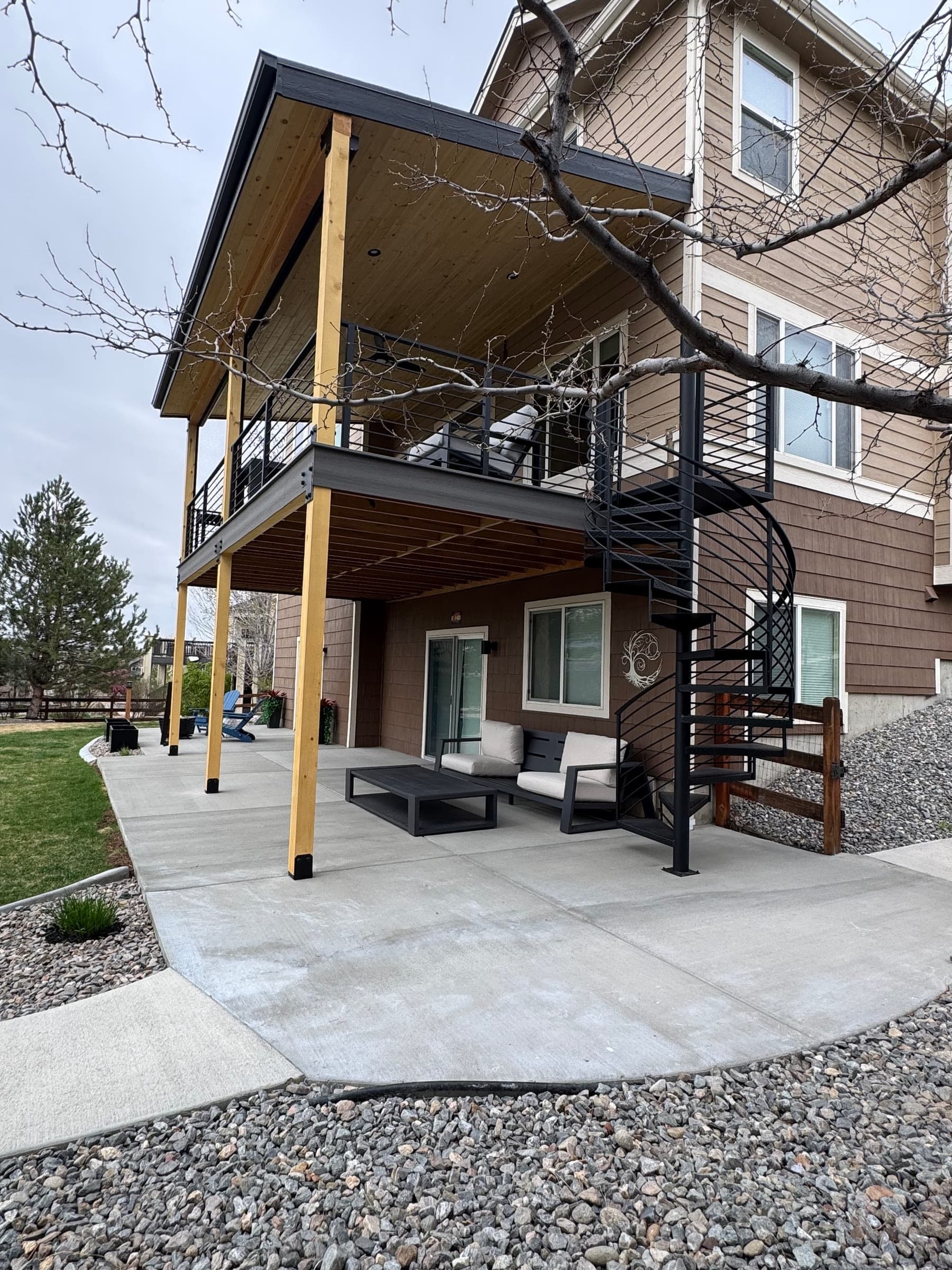
Why composite is our default in Colorado
Composite decking is the material we recommend to most homeowners across the Denver and Colorado Springs areas, and it isn't a close call. Colorado asks more of a deck than almost anywhere in the country: 300-plus days of high-altitude UV that bleaches and dries natural wood, summer hail that dents and splinters soft boards, and a freeze-thaw cycle that works fasteners loose and splits timber over a few short winters. Modern capped composite is built to shrug all of that off — the closest thing to a genuinely weatherproof deck this climate allows — which is why it's the surface under most of the decks we build.
What capped composite actually is
Today's composite boards are a dense wood-and-polymer core wrapped in a hard polymer cap — the reason you'll hear them called "capped" boards. That cap is what resists fading, staining, scratching, and moisture, the four things that age a wood deck fastest. Unlike the first-generation composites from twenty years ago, the boards we install won't turn gray, won't grow mold in shaded north-facing corners, and never need sanding, staining, or sealing. You wash them with soap and water a couple of times a year, and that is the entire maintenance schedule.
The brands we build with
We are a Deckorators Pro Elite installer, and Deckorators is our go-to line for Colorado because its mineral-based boards stay cooler underfoot and expand and contract less through big temperature swings than wood-flour composites — which matters when your deck routinely sees 30-degree daily swings in spring and fall. We're also a certified Trex Platinum Pro deck contractor and TimberTech dealer, and build in both brands when a specific color, grain, or budget calls for it. All three carry 25-to-50-year manufacturer warranties on fade and stain, and we back every installation with our own workmanship guarantee.
Designed and engineered for your yard
A composite deck is only as good as the structure underneath it. Every Haka Decks build starts with the footings, framing, and drainage — sized for Colorado snow loads, set below the frost line, and detailed so water sheds away from your foundation instead of pooling against it. From there we design the deck around how you actually use the space: a single level for easy entertaining, multiple tiers to step down a sloped Centennial lot, or a wraparound that follows the back of the house. We prepare the permit drawings, handle the HOA submittal, and bring in structural engineering when the design needs it, so the finished deck is fully approved and inspected — an asset when you sell, not a liability.
What it costs and how long it takes
A typical 300–400 square foot composite deck along the Front Range runs in the mid-five figures fully installed, including stairs, a complete railing system, lighting, and permits. Most builds take three to ten days on site once we break ground, following a two-to-four-week window for permits and material delivery. You'll get an itemized, written estimate before anything is ordered, so you can see exactly where the budget goes.
If you're weighing composite against wood — or you just want to know what your specific yard needs — tell us about your project and we'll come walk the space with you.