
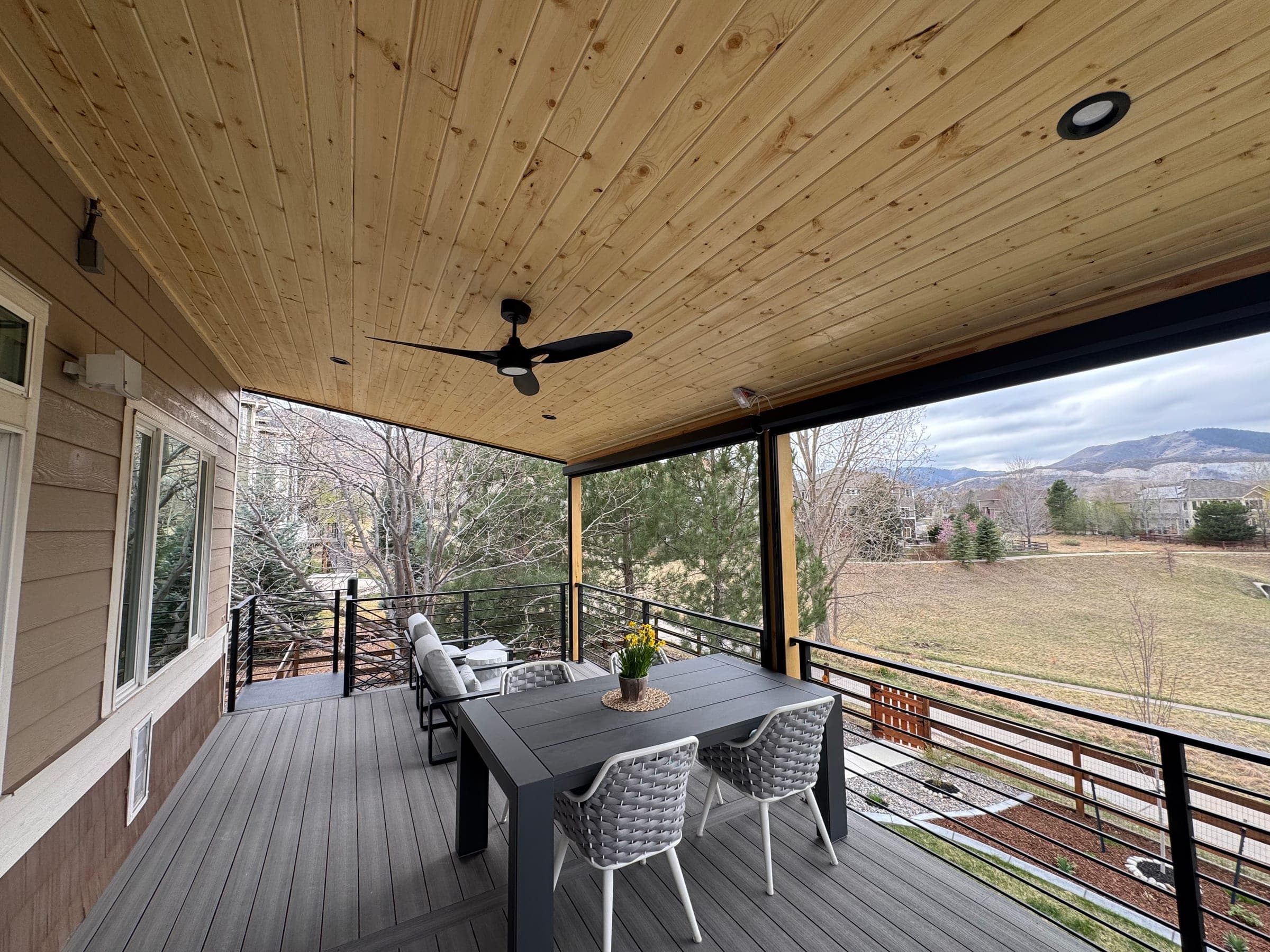
The crossroads town that grew
Johnstown sits where I-25 meets Highway 34 — Loveland one direction, Greeley the other, Denver an hour south — and that position turned a small farm town into one of the fastest-growing addresses in Northern Colorado. The pattern is a preserved historic core downtown, ringed by post-2000 master-planned subdivisions: Thompson River Ranch, Pioneer Ridge, Thompson Crossing, Johnstown Village.
Most of the houses here are young, most of the yards are open, and most of the decks are whatever the production builder shipped — turning that builder-basic backyard into the room the house was missing is the project we do most.
Starting from almost nothing is the good version
A new-build backyard — bare turf, a slab stoop, maybe a ten-by-ten platform — sounds like a disadvantage. It isn't. There's no failing structure to demolish and no old compromises to inherit. We design the composite deck, the shade, and the railing as one plan, size the footings correctly from day one, and the result reads like it came with the house.
If your builder deck already exists, we look before we quote. A sound frame can sometimes carry a new composite surface — a repair-scale project — while minimum-spec framing is usually better replaced outright with a deck sized for the yard.
Open plains, real wind, real hail
At about 4,850 feet on open Weld County plains, Johnstown lots take wind with nothing to slow it down and sit squarely in Colorado's hail alley. A pergola or patio cover on exposed ground is loaded upward in a windstorm — uplift — so engineered post bases and exposure-rated hardware are what keep it attached. And capped composite is the surface that takes hail and high-altitude UV without checking, splintering, or fading the way softwood does. Our composite vs. hardwood guide covers the trade-offs honestly.
The clay underneath
Weld County soils run to expansive clay — ground that swells wet and shrinks dry, and heaves shallow footings out of level a season at a time. Add Front Range freeze-thaw and the answer is non-negotiable: caisson footings drilled to full frost depth, 30 to 36 inches, on every build.
Permits, portals, and district review
The Town of Johnstown requires deck permits, filed through the eTRAKiT portal, with SAFEbuilt handling inspections. Master-planned neighborhoods often add HOA or metro-district review before the permit — and it can take longer. Our permit guide explains the general process.
Fifty-five minutes north, no asterisks
Johnstown is about 55 minutes up I-25 from our Centennial shop, in the same corridor as our work in Loveland and Greeley. The distance shapes scheduling — not your price, and not the guarantee that stands behind the work.
Run the cost calculator for a real starting number, then tell us about your backyard.