
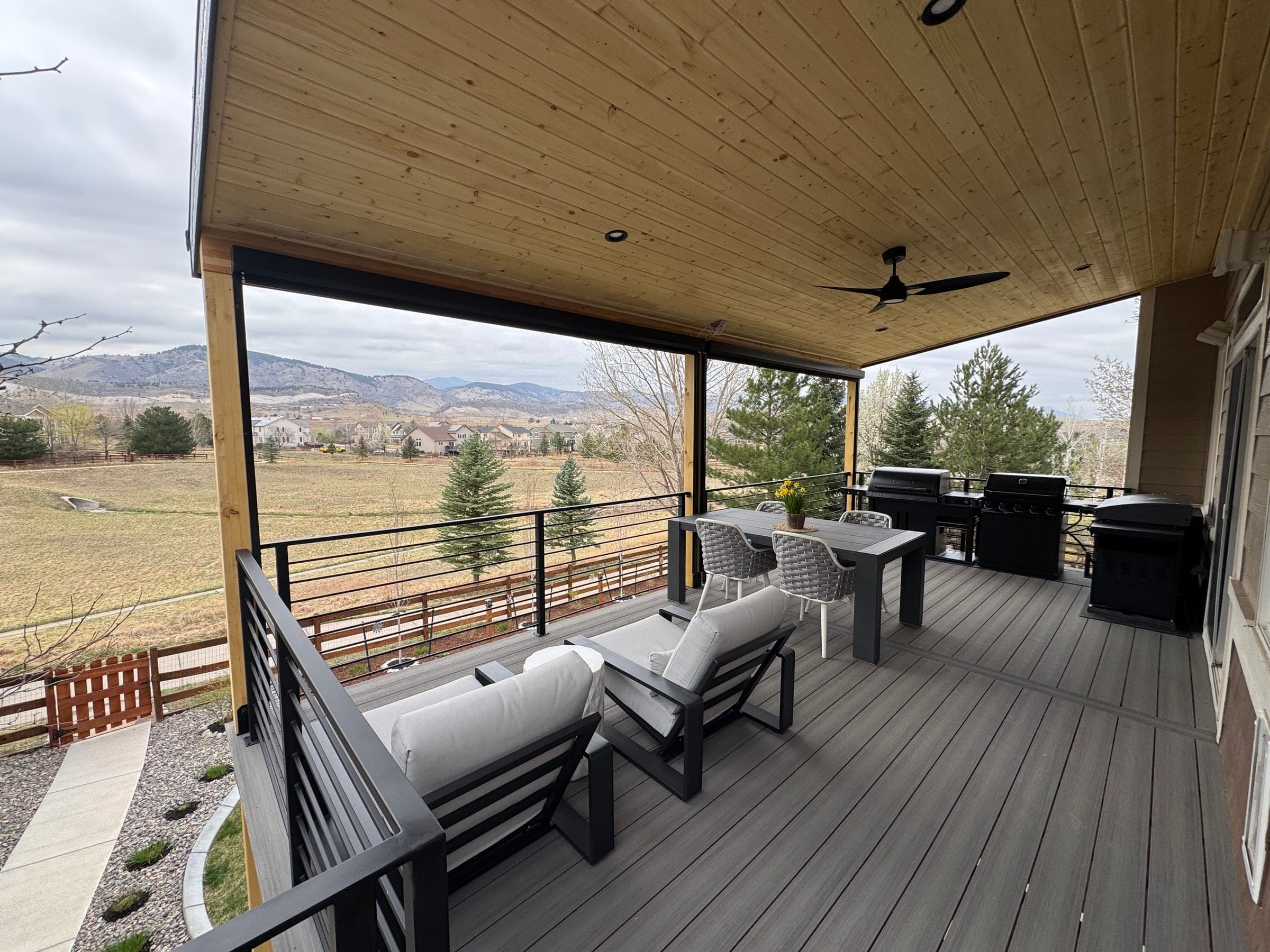
Old Town grid, brand-new edges
Frederick is a coal-heritage town that kept its original Old Town street grid — and then roughly doubled its population since 2010, to around 18,000, as master-planned neighborhoods grew up around that core: Wyndham Hill, the newly approved 1,850-unit Silverstone, Carriage Hills, Hidden Creek. The town itself documents metro districts as the norm for its new neighborhoods.
So Frederick decks come in two flavors: a first real deck for a young house that shipped with a slab and bare turf, or a right-sized rebuild where a builder-minimum platform has run out of excuses.
New-build backyards, done as one plan
The typical Frederick project starts from almost nothing: no failing structure to demolish, no old compromises to inherit. We design the composite deck, the shade structure, and the railing together, sized for how the yard will actually get used rather than what fit the builder's spec sheet. Where a small builder deck already exists, we inspect before quoting: a sound frame can sometimes take a new composite surface at repair scale, while minimum-spec framing is usually better replaced outright.
Wind on the Carbon Valley flats
At nearly 5,000 feet on the open Carbon Valley plains, Frederick lots take wind with a long, unobstructed run at them. Anything with a roof — a pergola or patio cover — is loaded upward in a windstorm, and uplift is what the engineering has to answer: post bases, hardware, and footings all specified for the exposure rather than for a sheltered suburb. It's the same standard we hold on open ground in Erie and Brighton.
Hail, sun, and why we lead with composite
Weld County sits in hail alley — Colorado is second in the nation for hail claims — and high-altitude sun is nearly as hard on a deck as the ice. Capped composite takes both without the graying or annual refinishing softwood demands. The trade-offs are in our composite vs. hardwood guide.
The clay problem you can't see
Expansive Front Range clay swells wet, shrinks dry, and heaves shallow footings out of level a little more every season. Our answer is the same on every build: caisson footings drilled to full frost depth, 30 to 36 inches, below the movement. It's the part of the job nobody photographs and the reason the deck is still level in year ten.
Permits, districts, and getting both right
Deck and porch permits run through the Town of Frederick Building Department on the Accela portal; district or HOA design review in the master-planned neighborhoods usually comes first and takes longer. We prepare the drawings, file both packets in the right order, and manage every inspection — the permit guide covers the general process.
Frederick is about 40 minutes up I-25 from our Centennial shop. That shapes crew scheduling, not your price and not the guarantee behind the work.
Get a real starting number from the cost calculator, then tell us about your backyard.