
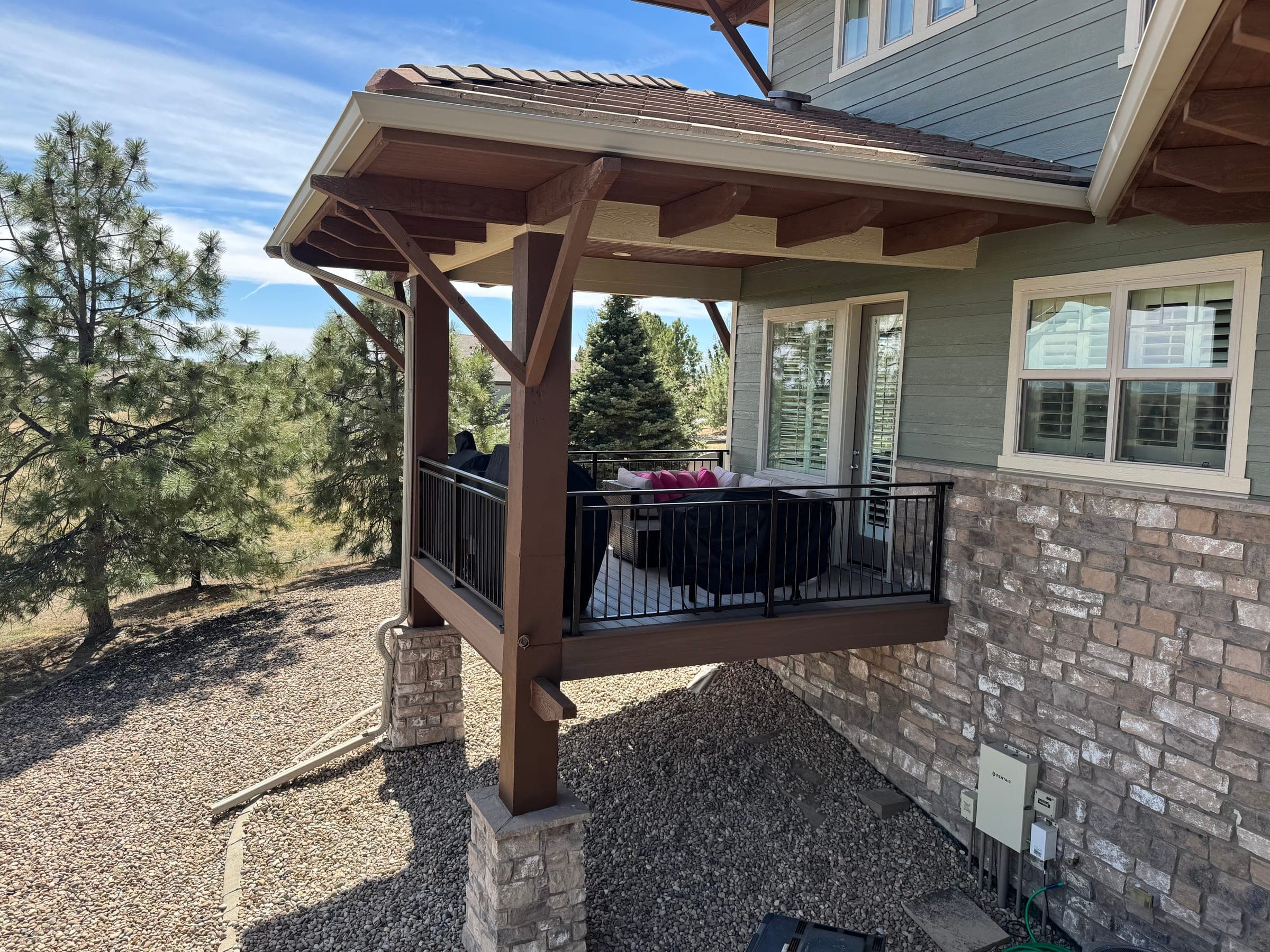
Your neighbor, not just your contractor
Haka Decks is headquartered in Centennial, in the heart of the greater Denver Tech Center — our shop sits off Easter Lane near Peoria. When we build in Willow Creek, Piney Creek, Foxridge, or Smoky Hill, we're working in our own backyard. That matters for more than sentiment: we know what Centennial's homes need, can be on site quickly during a build, and are still nearby years later. The same goes next door: decks in Greenwood Village are ten minutes from the shop, where a lot of our premium outdoor-living work happens.
Centennial custom decks, designed where they're built
"Custom" gets thrown around; here it's literal. Every Centennial custom deck starts with a designer standing in your yard — checking sun path, grade, and sight lines to the neighbors — before anything gets drawn. Then the same company runs the deck construction: our own crew, our own project lead, from the first footing inspection to the final walkthrough.
Most deck installation in Centennial is capped composite, because that's what this climate rewards. But we're not a one-material shop — wood deck installation in cedar or hardwood is still on the menu for homeowners who want it and accept the upkeep. Either way the framing underneath is pressure-treated, code-current, and engineered for our snow and wind loads; the surface is a choice, the structure isn't.
What Centennial homes ask of a deck
Most of Centennial's housing stock went up between the 1970s and the 1990s, and a large share of those decks are original or second-generation wood, now reaching the end of their lives. We replace a lot of them: south- and west-facing boards bleached and split by high-altitude sun, fasteners worked loose by freeze-thaw, framing that predates today's code. Our usual answer is a capped composite rebuild on new or reinforced framing — a deck that shrugs off the sun and hail that killed the last one.
Mature trees are the other Centennial signature. With forty years of growth, a good deck design works around a canopy rather than clearing it. Multi-level layouts, wrapped corners, and integrated pergolas and patio covers show up often here — along with slim cable and aluminum railing that keeps the sightlines open through the trees.
Not every aging deck needs to come out, either. When the framing underneath is genuinely sound we'll say so and quote a repair or re-deck rather than a full replacement — it's the same inspection either way, and you get the answer in writing.
How deck construction in Centennial actually runs
The process is the same whether it's a 200-square-foot re-deck or a two-tier build with a kitchen:
- Initial consultation — free, at your house, usually within the week. We measure, talk budget honestly, and look at what your yard wants.
- Design and quote — drawings from our deck designer, material samples you can hold, and a fixed number — not an estimate that grows.
- Permits and HOA — we produce the plans, file with the city, and handle your HOA's architectural review while you do nothing.
- Construction — most Centennial decks are installed in one to three weeks on site, with the same crew start to finish.
- Walkthrough and warranty — we walk every line of the build with you, then stand behind it in writing.
Because the shop is minutes away, mid-build questions get answered on site the same day, not by phone from across the metro.
Permits and HOAs in Centennial
Deck work in Centennial runs through the city's building division, and most established neighborhoods — Willow Creek, Piney Creek, Foxridge, and their neighbors — layer on HOA architectural review. We handle both: drawings, permit submission, HOA paperwork, and inspections, as part of every Haka build. Our permit guide for Centennial and the surrounding counties walks through the whole process.
Composite-first, for Centennial specifically
Centennial sits at about 5,800 feet with 300-plus days of sun, real hail seasons, and 30-degree temperature swings in spring and fall. That climate is exactly why we lead with capped composite — the material math simply works better here than it does at sea level. If you're weighing options, start with our composite vs. wood comparison or our cost breakdown for the Denver area.