
From the Platte Canyon to South Park
Park County starts where Jefferson County ends, at the top of Crow Hill on US-285, and runs from the Platte Canyon at Bailey — about 7,700 feet — up to the open basin of South Park, where Fairplay sits at nearly 10,000. The housing is cabins and 1970s-to-2000s mountain builds on lots that run from one acre to forty, with deep frost, heavy snow, and high wind everywhere in between. Around 17,000 people live in the county, and most of the ones within our regular reach live along the 285 corridor in the canyon.
Where we build in Park County
Bailey is our Park County anchor — the townsite and the subdivisions above it, Burland Ranchettes to Elk Creek Highlands. From there our regular range follows US-285 through the Platte Canyon: Shawnee, Grant, and the Park County side of Pine Junction, where the county line splits a community we also serve from the Jefferson County side through Pine and Conifer. Farther into South Park — Fairplay, Alma, Como, Hartsel, Lake George — we take projects case by case, and we'll tell you what the drive does to the schedule before you commit.
Permits: one county counter, filed online
The Park County Building Department, part of Development Services, issues permits for unincorporated Park County — Bailey and the canyon communities included — from the county seat at 856 Castello Avenue in Fairplay, with the lobby open Monday through Thursday from 7 a.m. to 5 p.m. Applications go through the county's CloudPermit portal, so the forty-five-minute drive from Bailey to Fairplay disappears. Planning and zoning questions go to Development Services. The county has adopted the 2018 IRC and directs Bailey-area projects to the Platte Canyon Fire Protection District for fire-mitigation requirements. We prepare one clean packet, file it, and carry it through inspections; the general background is in our permit guide.
Loads from the hazard tool
Park County does not publish a snow-load table. Since January 1, 2024, every set of plans must use ground snow load and ultimate wind speed from the ASCE Hazard Tool under ASCE/SEI 7-22, and the county publishes a snow-load map at maps.parkco.us. The numbers are parcel-specific and rise with elevation, so a covered deck or patio cover at 9,000 feet is engineered for meaningfully more than one in the Bailey townsite. We pull the figures for your address, size beams, posts, and footings to them, and set footings below Colorado's 30–36 inch frost line.
Composite, for the weather this county supplies
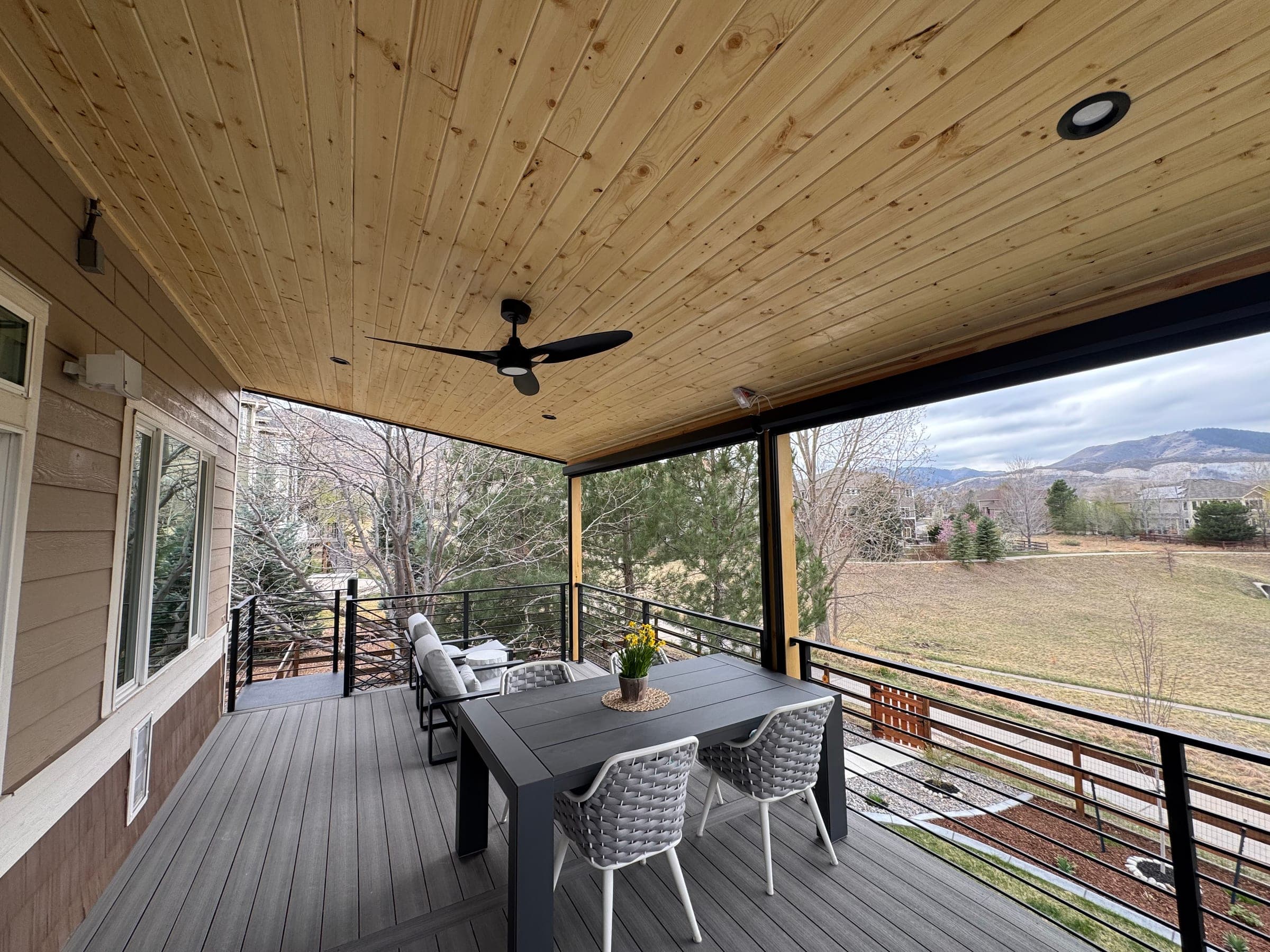
Altitude UV, freeze-thaw, wet spring snow, high wind: this is the weather capped composite was built for, and why we lead with it over softwood that starts an annual refinishing clock at 8,000 feet. It also adds no flammable mass to the edge of the house. Acreage lots want more deck — walkouts on steep grades, covered sections that keep the deck useful in winter, and railing that keeps the canyon in view. Where an existing frame is sound we say so and price a re-deck; where it cannot carry the parcel's load, a replacement on current-code structure beats repairing twice.
The drive, honestly
From our shop in Centennial, Bailey is about sixty-five minutes and the rest of the canyon corridor runs to seventy-five. We batch Park County visits with our Conifer, Pine, and Buffalo Creek work and schedule mountain builds around the snow calendar. Distance shapes scheduling, never the price or the warranty. Run the cost calculator for a planning range, then tell us what you are planning.