
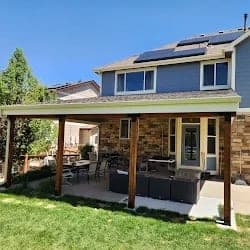
The highest county we build in
Summit County is Colorado's highest-population ski county, almost entirely above 8,800 feet. The housing splits three ways: resort condos at Keystone and Copper Mountain, 1970s-to-90s hillside subdivisions, and custom homes on forested lots that climb past 10,000 feet around Breckenridge and Blue River. Nearly every one has a view deck facing the Tenmile or Gore ranges.
Where we build in Summit County
Breckenridge is the county seat and the heaviest snow load we design for, with town code setting 90 psf below 10,000 feet and 100 psf above. Frisco is the walkable lakeside grid, with Frisco Heights and Bills Ranch climbing above Main Street. Silverthorne is the year-round hub on the Blue River, with Wildernest and Mesa Cortina on its west-facing hillsides. Dillon sits on the reservoir with a two-step permit. Beyond the towns we serve the unincorporated county too: Keystone, Copper Mountain, Blue River, and Summit Cove.
Permits: one county counter, three towns
The Summit County Building Inspection Department is at the County Commons on Peak One Drive in Frisco — not the county seat — and issues permits for unincorporated addresses through the eTRAKiT portal. By agreement it also handles Dillon's building permit, after the town issues its own development permit. Silverthorne and Frisco run their own building departments with plan review and inspections contracted to CBCS, and Breckenridge runs its own Building Division on Tyler EnerGov. Every county permit also needs fire-district sign-off — Summit Fire & EMS or Red, White & Blue — on its fire-hazard mitigation plan. The county adopted the 2024 I-Codes with amendments effective July 1, 2026. We confirm the counter from your parcel, prepare one packet, and manage inspections through final.
The wildfire code sets the surface
Summit County applies the Colorado Wildfire Resiliency Code to every permit applied for after May 4, 2026, and the whole county is designated moderate-to-high fire intensity, which triggers Class 2 hardening. For decks: surfaces and stair treads must be noncombustible, Class A-rated, fire-retardant-treated exterior wood, or ignition-resistant material. New homes of 4,500 square feet and up need sprinklers, roofs must be Class A, vents are capped at 3/16 inch, and defensible space is required. Capped composite that meets the ignition-resistance standard is what most Summit County decks will get, and we detail the framing underneath so embers have nowhere to nest.
Snow by subdivision, footings at forty inches
The county's Building Inspection Matrix assigns roof snow loads by subdivision: Town of Dillon 70 psf, Keystone-area PUDs 75, Frisco Heights 80, Breckenridge-area subdivisions 90 to 100. Frost depth is 40 inches countywide, design wind is 115 mph, and seismic is Zone B. Those numbers size every beam and post under a covered deck or patio cover — why a Breckenridge cover carries roughly twice the structure of a Dillon one. Our guide to how much snow a deck can hold explains the difference. Where an existing frame is sound we price a re-deck; where it is not, we recommend a replacement, in writing either way.
Two hours, scheduled in blocks
From our shop in Centennial, Summit County is 100 to 120 minutes via I-70 and the Eisenhower Tunnel, well past our Georgetown and Idaho Springs work. We schedule mountain builds in consecutive-day blocks, and for second-home owners we coordinate with property managers for access and photo updates. Distance shapes the calendar, never the price or the guarantee. Run the cost calculator for a planning range, then tell us what you are planning and which subdivision you are in.