
A Victorian town that decided to stay one
Georgetown sits at 8,530 feet at the head of the Clear Creek valley, and it is one of the best-preserved Victorian silver towns in Colorado: 1870s to 1890s frame and brick homes on small gridded lots along the Rose Street and Taos Street blocks and Argentine Street, a historic 6th Street downtown, and newer homes out toward Georgetown Lake and up the Guanella Pass road. It is also the county seat — the Clear Creek County building office is here on Rose Street — and the Georgetown–Silver Plume district has been a National Historic Landmark since 1966.
Design review comes before the permit
Georgetown passed Colorado's first historic preservation and design review ordinance in 1970, and it still runs on it. Exterior remodeling, additions, and new construction anywhere in town — decks included — need a Certificate of Appropriateness from the Design Review Commission before a building permit is issued. The DRC meets the second and fourth Thursdays at 6 pm at Town Hall, with applications due fourteen days prior, so the calendar matters: miss a submittal window and the project slides a month. Once the certificate is in hand, Town of Georgetown Building Services takes the permit application online through CommunityCore, and SAFEbuilt handles plan review and inspections on 24-hour notice. The town has adopted the 2024 IRC. Addresses outside town limits go through Clear Creek County instead.
Engineering for 8,500 feet
Clear Creek County's design criteria set the structural numbers: a 42-inch minimum frost line with deck piers at least 36 inches below grade, Seismic Design Category B, and a roof snow load looked up by elevation on the county's ClearMap table. The town's own building page adds a winter design temperature of 1°F and an Air Freezing Index of 1000 — a long, hard freeze that works every fastener and heaves any footing that is too shallow. A covered deck or patio cover here is engineered to that snow figure, not picked from a catalog. The county also enforces the 2025 Colorado Wildfire Resiliency Code with a defensible-space site plan; we confirm with Building Services how it applies inside town.
Composite that fits a historic street
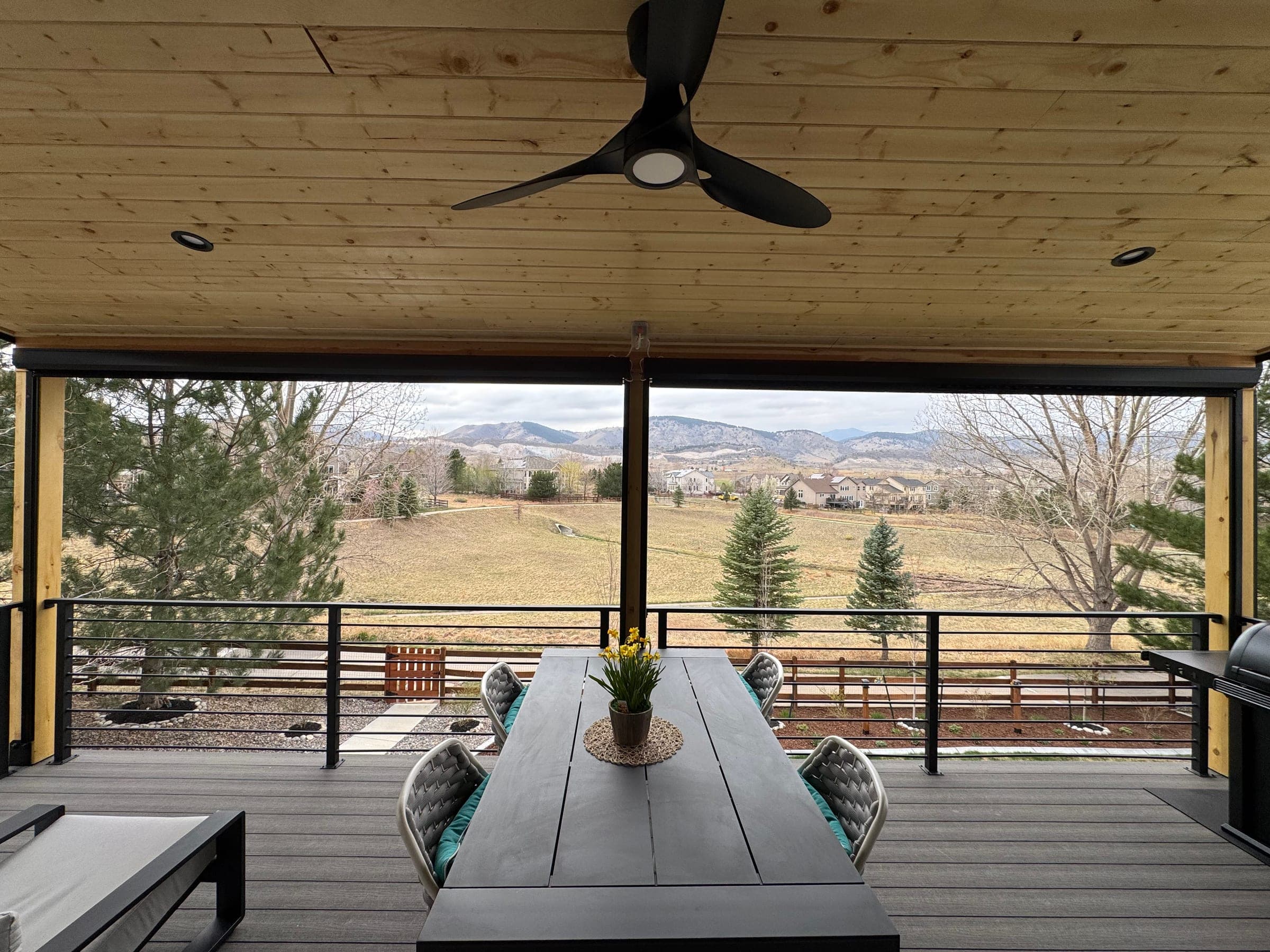
A deck on a Victorian block has to look right from the sidewalk and survive nine months of freeze and three of high-altitude sun. Capped composite in a muted tone does both, and it ends the annual refinishing that wood demands at this elevation. We bring the material samples into the DRC conversation rather than after it. Where the view is up the valley, slim aluminum or cable railing keeps it; where the street matters more, a composite baluster rail reads closer to the period.
Older decks, inspected before we quote
Decks added to 1880s houses over the last fifty years vary widely in how they were framed. We inspect first. Sound structure earns a re-deck in composite, and a smaller DRC conversation; an undersized frame gets a replacement plan on current-code structure, in writing either way.
Seventy minutes, planned around the DRC calendar
Georgetown is about 70 minutes from our Centennial shop, up I-70 past Idaho Springs, with Silver Plume one exit further and Empire up US 40. We schedule mountain work in blocks so a crew stays for consecutive days, and we time the build around the DRC and permit dates. Run the cost calculator for a planning range, then tell us what you are planning and we will start with the DRC dates.