
A silver camp on the way to Berthoud Pass
Empire is small — about 345 people — and old, an 1860s silver camp in a sunny, star-shaped valley where US 40 leaves the I-70 corridor and starts climbing toward Berthoud Pass and Winter Park. The Park Avenue historic core is compact lots with small frame homes and cabins from the mining era, with newer houses scattered up North Empire Road and along Bard Creek. At 8,615 feet, the town sits high enough that snow is the design brief for anything built outdoors.
Permits: we confirm the path before we draw
The Town of Empire publishes no building-permit application — its Applications & Permits page posts excavation and undergrounding, conditional-use, and short-term-rental forms, nothing for a deck. Town zoning runs under Ordinance 170, and the Town Clerk at Town Hall on East Park Avenue is the first call for any permit question. The Clear Creek County Building Department in Georgetown serves unincorporated parcels and answers code questions, with applications through its GovBuilt portal. So before we design anything in Empire, we call Town Hall and confirm whether the town or the county processes a residential deck permit for your address, then prepare one clean packet for whichever counter it is. The Clear Creek County page covers the county side in more detail.
Snow by elevation, piers at 36 inches
Empire does not publish its own design loads, so the county's design criteria are the reference: a 42-inch minimum frost line, deck piers at least 36 inches below grade, and a roof snow load looked up by elevation on the county's ClearMap table rather than a single figure. At roughly 8,600 feet on the pass approach, expect the heavy end of that table, plus drifting where the valley funnels wind. That is what sizes every beam, post, and footing under a covered deck. The county also requires 2025 Colorado Wildfire Resiliency Code compliance and a three-zone defensible-space plan with county permits, and we detail for embers regardless of which counter applies.
Composite on compact lots
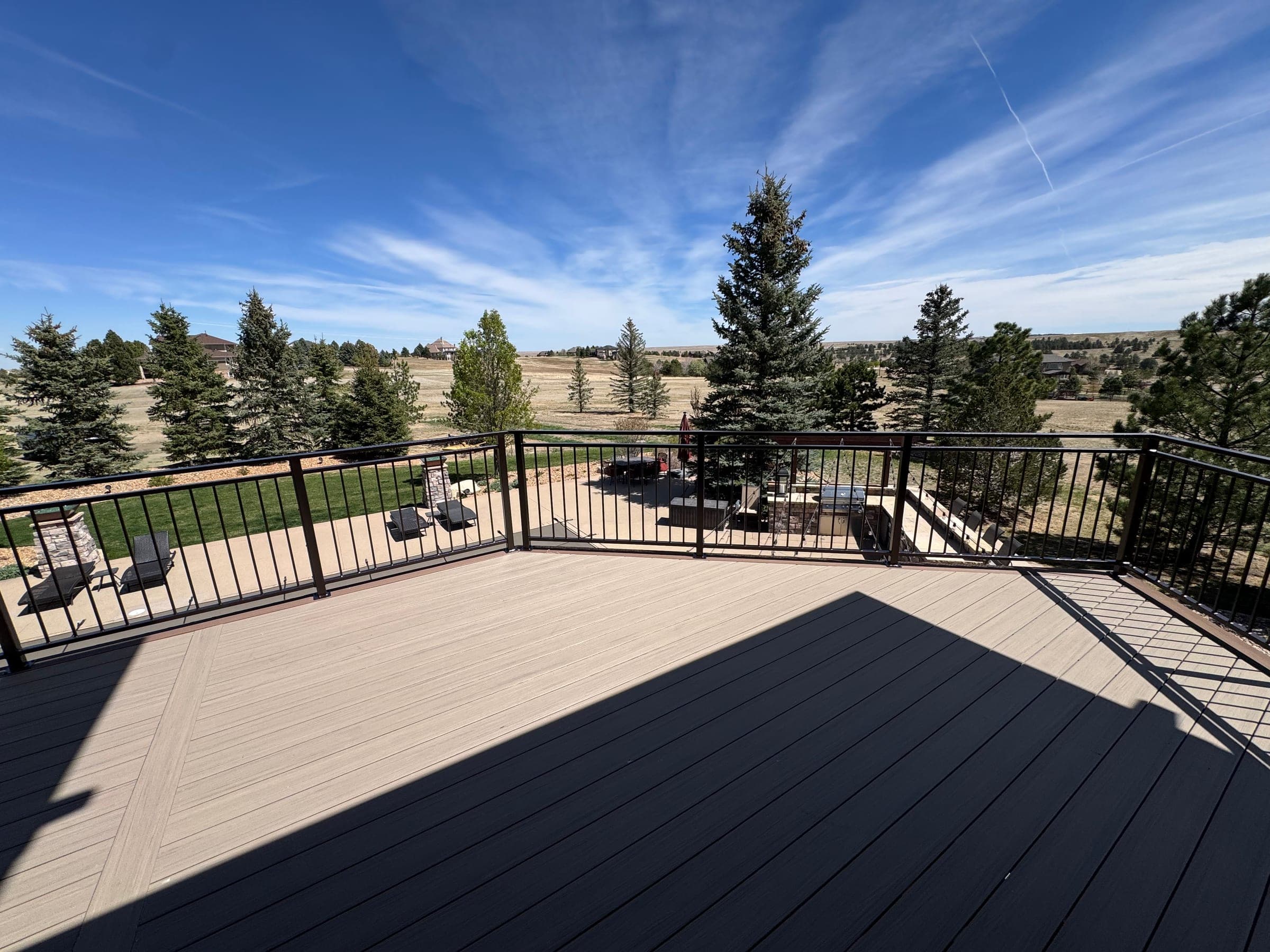
An Empire deck is usually modest in footprint and hard-working: a cabin's only outdoor room, shoveled all winter and baked by altitude sun all summer. Capped composite handles both — no annual refinishing, no meltwater soaking into the boards before a freeze. Slim aluminum or cable railing keeps the valley walls in view instead of behind pickets, and on a small lot that view is most of the reason for the deck.
Old cabin decks, inspected first
Many Empire decks were added to mining-era houses long ago, framed light and hung on unflashed ledgers. We look before we quote. Sound framing earns a re-deck in composite for far less than a teardown; an undersized or rotted frame gets a replacement recommendation on current-code structure. The answer comes in writing either way.
A little over an hour, scheduled in blocks
Empire is about 65 minutes from our Centennial shop, up I-70 past Idaho Springs and onto US 40, with Georgetown a few miles further along the interstate. We group mountain-corridor work so crews stay on site for consecutive days instead of commuting for half-days — that shapes the calendar, not the price or guarantee. Run the cost calculator for a planning range, then tell us what you are planning.