
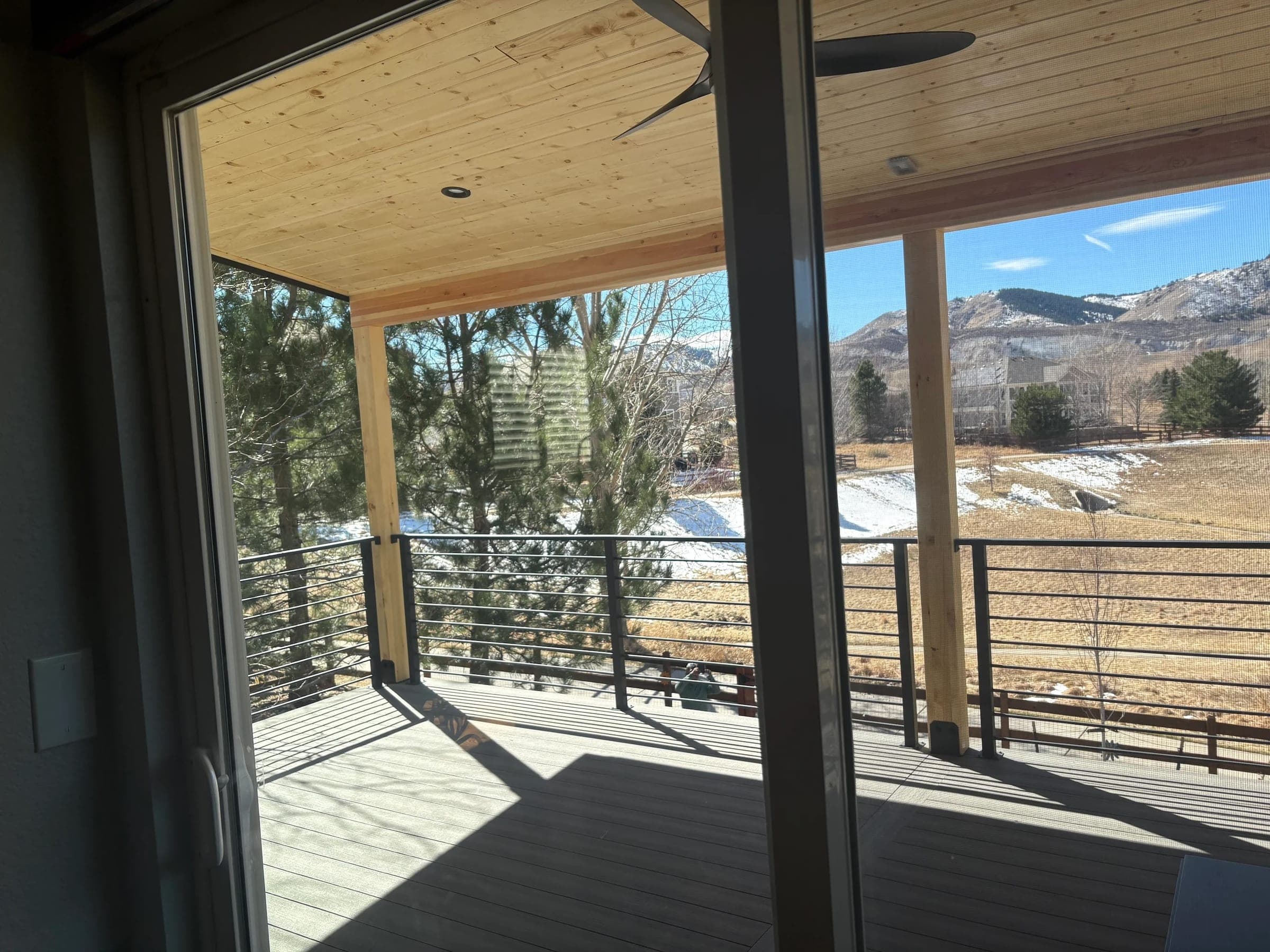
Two counties in one
Jefferson County is really two places wearing one name. On the flats, it is Denver's western suburbs, built out largely between the 1960s and the 1980s, with mature trees and a huge stock of original wood decks. In the foothills, it is forested, steep, and fire-mapped, climbing to 8,000 feet and beyond. The two halves need different decks, and since mid-2026 they answer to meaningfully different rules.
Where we build in Jefferson County
Lakewood is the county's biggest city and steady replacement work; Golden sits against the mesas where wind starts mattering. Arvada and Wheat Ridge are classic 1960s-to-80s suburbs full of decks aging out together. Up the hill, Evergreen and Conifer are true mountain building — snow loads, steep lots, and WUI-mapped parcels — while Morrison straddles the transition and Ken Caryl tucks its valley neighborhoods right against the hogback.
Permits: Jeffco and five city counters
Jeffco Building Safety issues permits for unincorporated addresses — Ken Caryl, Conifer, most Morrison-area addresses, and Evergreen — while Lakewood, Golden, Arvada, Wheat Ridge, and Westminster run their own counters with their own habits. The background is in our permit guide.
The wildfire code changed the default
Jefferson County's Wildfire Resiliency Code took effect July 1, 2026. In mapped WUI zones, new and replacement deck surfaces must be noncombustible, with ignition-limiting framing underneath. It is parcel-specific — we check the map for every foothills address before drawing — and on mapped parcels, untreated softwood is off the table: capped composite is the code-aligned choice. We were building fire-aware in these hills before the code required it — framing bays screened against embers, undersides kept clear of stored fuel.
Foothills structure, flatland replacement
Mountain parcels here ask for real engineering: snow loads that size every beam under a covered deck, frost-depth footings, and walkout structures that make steep lots livable. Down on the flats, the work is mostly the replacement cycle on wood decks whose frames we inspect before quoting anything. Sound framing gets a re-deck; finished framing gets a replacement on current-code structure, and we put that answer in writing either way. If you want to gauge your own deck first, start with the deck safety inspection guide.
The drive, honestly
From our shop in Centennial, the county's near edge is about half an hour and the high foothills closer to an hour. That shapes scheduling — we batch mountain site visits, and fall contracts win the spring calendar, as our guide to the best time to build in Colorado explains. It does not shape the price or the guarantee. Run the cost calculator for a planning range, then tell us what you are planning — for foothills addresses, we will bring the WUI map answer for your parcel.