
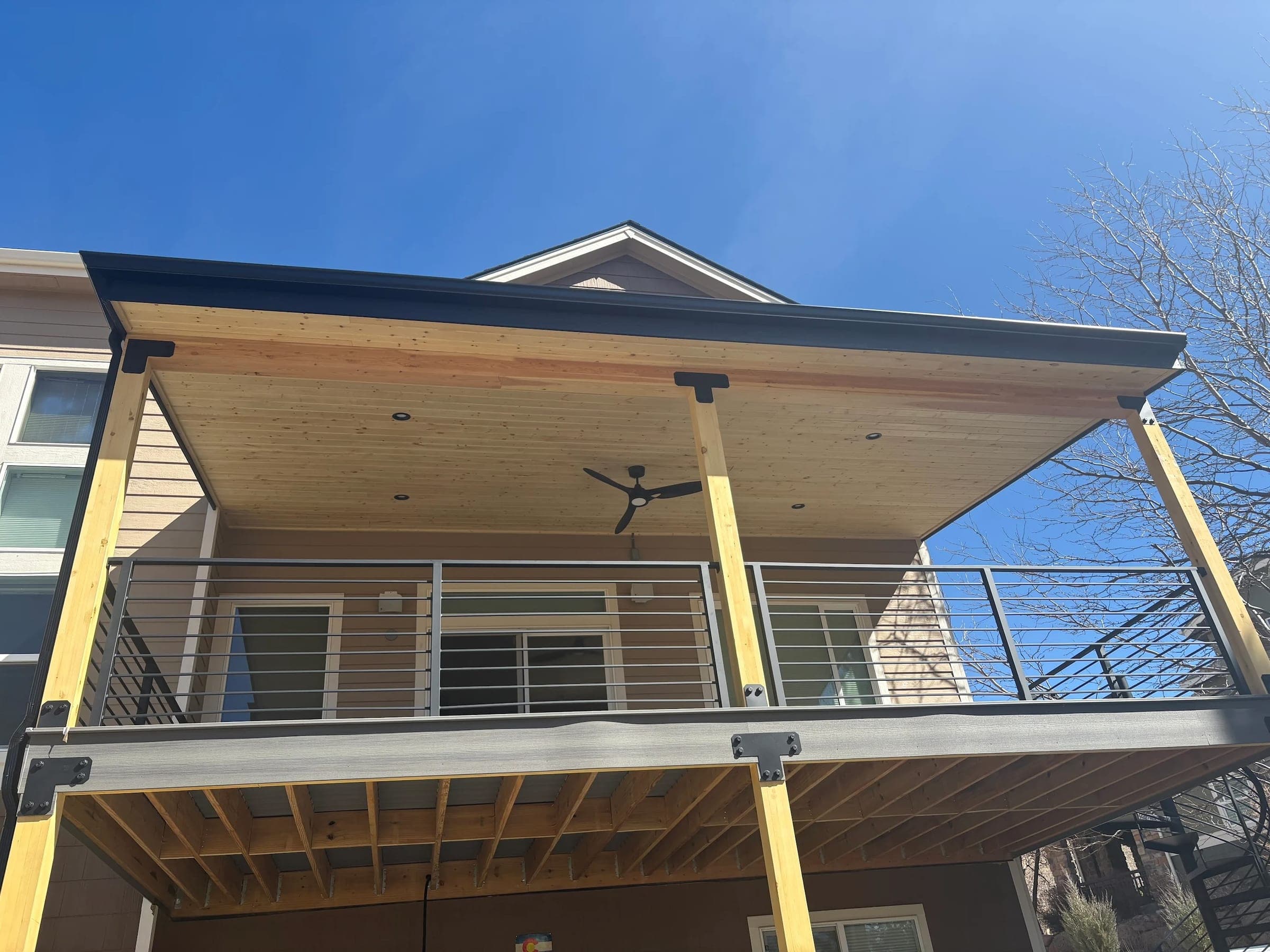
Parmalee Gulch at 7,200 feet
Indian Hills runs along Parmalee Gulch Road between Morrison and Highway 285 — about 1,300 people at roughly 7,200 feet, protected by Indian Hills Fire Rescue. The housing is two eras layered together: 1920s summer cabins converted to year-round homes, and 1970s-to-2000s custom builds on wooded one-to-three-acre lots through Pine Vista and out toward the Mt. Falcon side. Driveways are steep and the snow shade is heavy. A deck here needs to carry real load, drain a wet spring, and survive UV that would strip a wood finish in a season or two.
Permits: Jefferson County Building Safety, plus the wildfire code
There is no town hall in Indian Hills. Permits come from Jeffco Building Safety at 100 Jefferson County Parkway in Golden, with applications and inspection requests through the county's CitizenPortal. Since July 1, 2026, the county's Wildfire Resiliency Code applies to permits in unincorporated Jeffco: on parcels inside the mapped WUI overlay, deck surfaces must be noncombustible and the framing must limit ignition, and the rule covers exterior alterations such as deck replacements and additions. The county also requires nonflammable fencing within eight feet of structures and no flammable material within five feet. Map status is parcel-specific, and we check it before designing. Our permit guide explains the process; our Jefferson County page explains how the county fits together.
Fifty-seven to sixty psf
Jefferson County tiers snow load by elevation, and Indian Hills sits between the 7,000-foot line (54 psf ground snow) and the 7,500-foot line (67 psf). Most parcels here land around 57–60 psf — a structural number that sizes every beam and post under a covered deck or pergola, and one that the heavy shade on these lots makes more demanding, since the snow that lands stays. Frost depth is 36 inches, wind is designed at 129 mph in Exposure B, and the county classes weathering as severe. Footings go to frost, and connectors are rated for freeze-thaw.
Acreage decks, built for the code
Wooded acreage changes the brief. Indian Hills homeowners usually want a larger deck than a subdivision lot allows, often with a covered section so it works more than five months a year, and railing that keeps the trees and the ridge in view. On WUI-mapped parcels, capped composite is the code-aligned surface, and it is the right call here regardless — it does not start the refinishing clock that shade and altitude UV impose on softwood. We were framing fire-aware in these hills before the code required it: bays screened against embers, undersides kept clear of stored fuel.
Converted-cabin decks, honestly assessed
Many Indian Hills decks went on when the cabins were still seasonal, built to snow loads and hardware the county no longer accepts. We inspect before we quote. Sound framing gets a re-deck at $20–$35 per square foot over the existing structure; framing that has aged out gets a replacement on current-code structure. The answer comes in writing either way.
Forty-five minutes from Centennial
From our shop in Centennial, Indian Hills is about forty-five minutes — past our Ken Caryl work at the foot of the hogback, then up Parmalee Gulch from Morrison or in from Highway 285. We batch mountain site visits and schedule builds around the snow calendar. Run the cost calculator for a planning range, then tell us what you are planning and we will bring the WUI map answer for your parcel.