
Weld County proportions
Greeley has never had to be stingy with space, and that shapes the work. Lots run generous, the horizon is wide open in most directions, and the newer neighborhoods on the edges of the city were laid out on farmland with the same relaxed relationship to acreage that the surrounding county has always had.
For deck design that's an opportunity and a trap in equal measure: you can build what the house actually wants rather than what fits between the setbacks, but a standard suburban platform dropped onto a Greeley lot reads as undersized, like furniture borrowed from a smaller house.
Build zones, not a platform
The projects that work here are usually zoned — a covered section for cooking and eating, an open section for sun, and often a lower level stepping toward the yard.
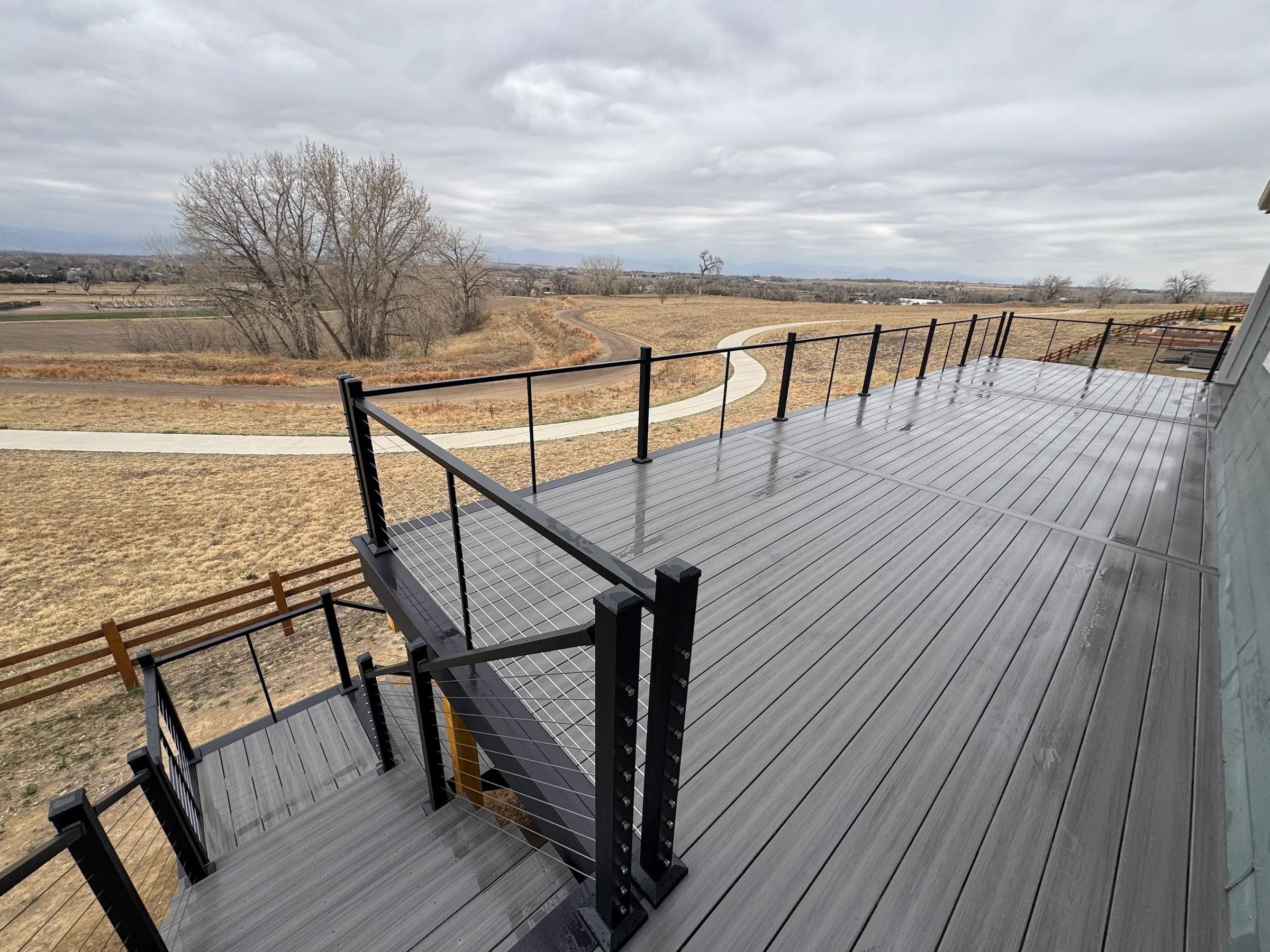
Built-in seating earns its keep on lots like these, because people gather in numbers and nobody wants to carry chairs across a yard this size. Lighting matters just as much — the long evenings are the point of having the space. And for the surface itself, capped composite is the straightforward answer: an unshaded deck out here takes full high-altitude UV all day, serious hail seasons, and sharp freeze-thaw swings.
Wind is the design load
There's a lot of open farmland upwind of most Greeley neighborhoods, and anything with a roof over it gets loaded upward in a windstorm rather than pressed down by snow — so post bases, connections, and footings on a pergola or solid patio cover all get specified for uplift.
Solid roofs catch more wind than open pergolas and need it more. This is the same engineering we bring to Brighton's big lots and Erie's prairie, and explains why a properly engineered cover costs more than the cheapest number you'll be quoted.
Older neighborhoods, honest inspections
Greeley's established core has housing old enough that its decks are usually second-generation and overdue. Our approach doesn't change: inspect the structure before quoting the surface, starting with the ledger connection where the deck meets the house, because that's where the expensive failures live.
If the framing is genuinely sound, a re-deck puts a new composite surface on the structure you already own for meaningfully less. If it isn't, a full replacement on code-current framing is the right call and we'll explain exactly why. Written either way — including when the cheaper answer wins.
Where a lot opens west, railing choice is worth the spend: slim aluminum or cable keeps the Front Range on the horizon instead of behind a fence of pickets.
City or county
Inside city limits the City of Greeley is your counter; outside them it's Weld County, and the two aren't interchangeable — worth confirming first, since so many Greeley properties sit close to that line. We do that, then produce drawings to the right standard, file the permit, and manage inspections through sign-off.
The drive, plainly
Greeley is roughly an hour from our shop in Centennial. So we take projects here that justify the trip — full builds and covered structures rather than small repairs we couldn't service well from that distance — and we plan the logistics before quoting.
Distance doesn't change the engineering, the manufacturer certifications behind the materials, or the written guarantee that covers the work. Try the cost calculator or read the cost guide first if you'd like, then tell us about your lot.