
The south end of Carbon Valley
Dacono sits at I-25 and CO 52, about 5,050 feet up on rolling ground at the southern end of the Carbon Valley — the first Weld County city you reach from Denver. Roughly 6,500 people live here. The center is the old coal-camp grid of 1900s–1970s homes in Old Town; north and east of it, the 2000s through the 2020s added Sharpe Farms, the Glens at Dacono, and Sweetgrass on lots that roll more than the flat towns up US 85, over clay that moves.
Permits under the 2024 codes
The City of Dacono's Community Development department issues permits from 512 Cherry Avenue, with SAFEbuilt Colorado providing building department services — plan review and inspections. Applications, plan submittals, and payments go through Community Core. Dacono adopted the 2024 I-Codes effective December 17, 2025, so a deck here is reviewed against the current edition, and some submittals also route to the Mountain View Fire Protection District. We prepare the plans, file, and manage inspections through final. Parcels outside city limits file with Weld County, and we confirm the jurisdiction from your address first.
Clay, wind, and sun
Dacono publishes no design criteria of its own, so the regional Weld County values govern: 30 psf ground snow, 115 mph three-second-gust wind, and a 30-inch frost depth. Two of those matter most here. The clay under Dacono heaves shallow footings, so ours are drilled to full frost depth rather than set on pads — the single most common failure we see on older decks in the Carbon Valley. And the wind sizes any pergola or patio cover for uplift, with roof connectors and post bases chosen to hold in a spring gale.
Hail and sun decide the surface. Weld County is hail country, and a south-facing deck at this elevation takes UV that fails a wood finish in two seasons. Capped composite takes both and asks for a hose instead of a stain.
What we build in Dacono
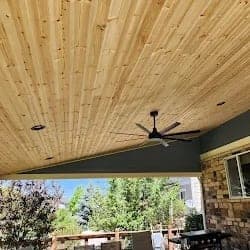
On the rolling subdivision lots, some homes have a walkout or a back door a few feet above grade, and the deck goes up with it — taller posts, engineered footings, and railing that has to be right. The typical project pairs a 300–400 square foot composite deck with a pergola for shade, since there is not a mature tree in most of these neighborhoods. Downtown, the work is fitting a useful deck inside a small setback. We are a Trex, TimberTech, and Deckorators dealer, and every build carries our two-year workmanship warranty.
Repair or replace
The 2000s subdivisions have decks reaching the age where surfaces and railings fail on frames that are often still sound. We inspect the ledger, posts, footings, and hardware first. Sound structure gets a re-deck at $20–$35 per square foot; a failed ledger or footings above frost get a replacement plan built to the 2024 code.
Forty-five minutes up I-25
Dacono is about forty-five minutes from our Centennial shop, straight up I-25 — the near end of our Weld County range and a routine run, alongside our Frederick and Firestone work a few minutes north. The drive shapes scheduling, not the price or the guarantee.
Run the cost calculator for a planning range, then tell us what you are planning.