
From coal camp to boomtown
Firestone was a coal town — Miners Park keeps the name honest — and for most of a century it stayed small. Then the Front Range grew north: roughly 1,900 people in 2000 became more than 16,000 by 2020. About 82 percent of its housing was built after 2000, in master-planned communities like Barefoot Lakes on its two lakes and the St. Vrain, St. Vrain Ranch, golf-adjacent Saddleback, and Eagle Crest.
The practical upshot: nearly every backyard in town is young, open, and finished to whatever minimum the production builder shipped. That's the gap we fill.
The first real deck, not the second
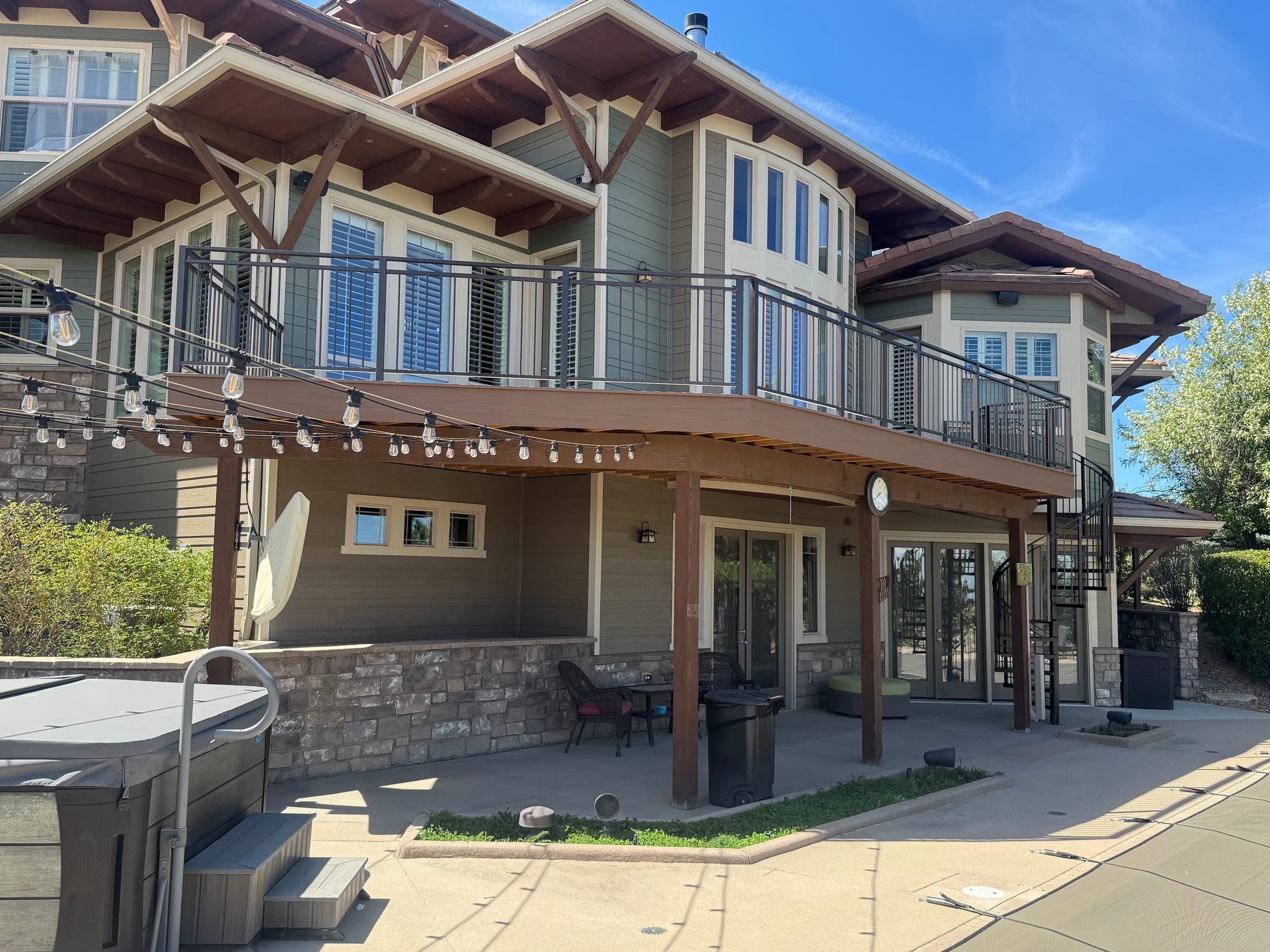
A bare yard or a code-minimum platform is the easy case: we design the composite deck, shade, and railing as a single plan, put the footings where they belong, and nothing about the result says afterthought.
Where a builder deck does exist and the frame checks out, a re-deck at repair scale can be the honest quote; where the framing was sized to the bare minimum, a proper replacement is better money. We inspect first and say which.
Carbon Valley wind is an engineering input
Firestone sits at nearly 5,000 feet on flat, open Carbon Valley plains — the tri-town stretch it shares with Frederick and Dacono — with little to block the wind. For a pergola or patio cover, that makes uplift the governing load: wind pulling the roof upward rather than snow pressing down. Engineered post bases, exposure-rated hardware, and footings sized for the load are the difference between a cover that stays and one that leaves in a spring storm. It's the same logic we apply on open ground in Erie and Brighton.
Hail alley, high sun, and material choice
Weld County is the heart of Colorado's hail belt, and the state runs second nationally in hail claims; high-altitude UV also grays and checks softwood in a few seasons. That's the core of the composite-first case: capped boards take the impact and the sun without a yearly refinishing weekend. See the full comparison.
Clay soils and honest footings
Front Range expansive clay swells when wet, shrinks when dry, and heaves shallow footings out of level. Add freeze-thaw and the answer is drilled caisson footings to full frost depth — 30 to 36 inches — on every build. It's the least visible line item in the quote and the one doing the most work a decade out.
Permits, districts, and the 40-minute truth
The Town of Firestone Building Division permits deck work, with SAFEbuilt handling inspections; metro-district and HOA design review comes standard in the master-planned neighborhoods and usually runs first. Our permit guide covers the process.
Firestone is about 40 minutes up I-25 from our Centennial shop — close enough that Carbon Valley scheduling is routine and never touches your price or the guarantee.
Start with the cost calculator, then tell us what you're planning.