Ranch country, twenty minutes out
Franktown is what the south metro looked like before the master plans arrived: custom and ranch homes on five-plus acres, horse-friendly zoning, ponderosa woodland breaking into open ranch land, and Castlewood Canyon's rimrock as the local landmark. Neighborhoods like Russellville — five- and six-acre equine properties — Deerfield, and Bannockburn set the scale, with The Pradera just over the Parker line.
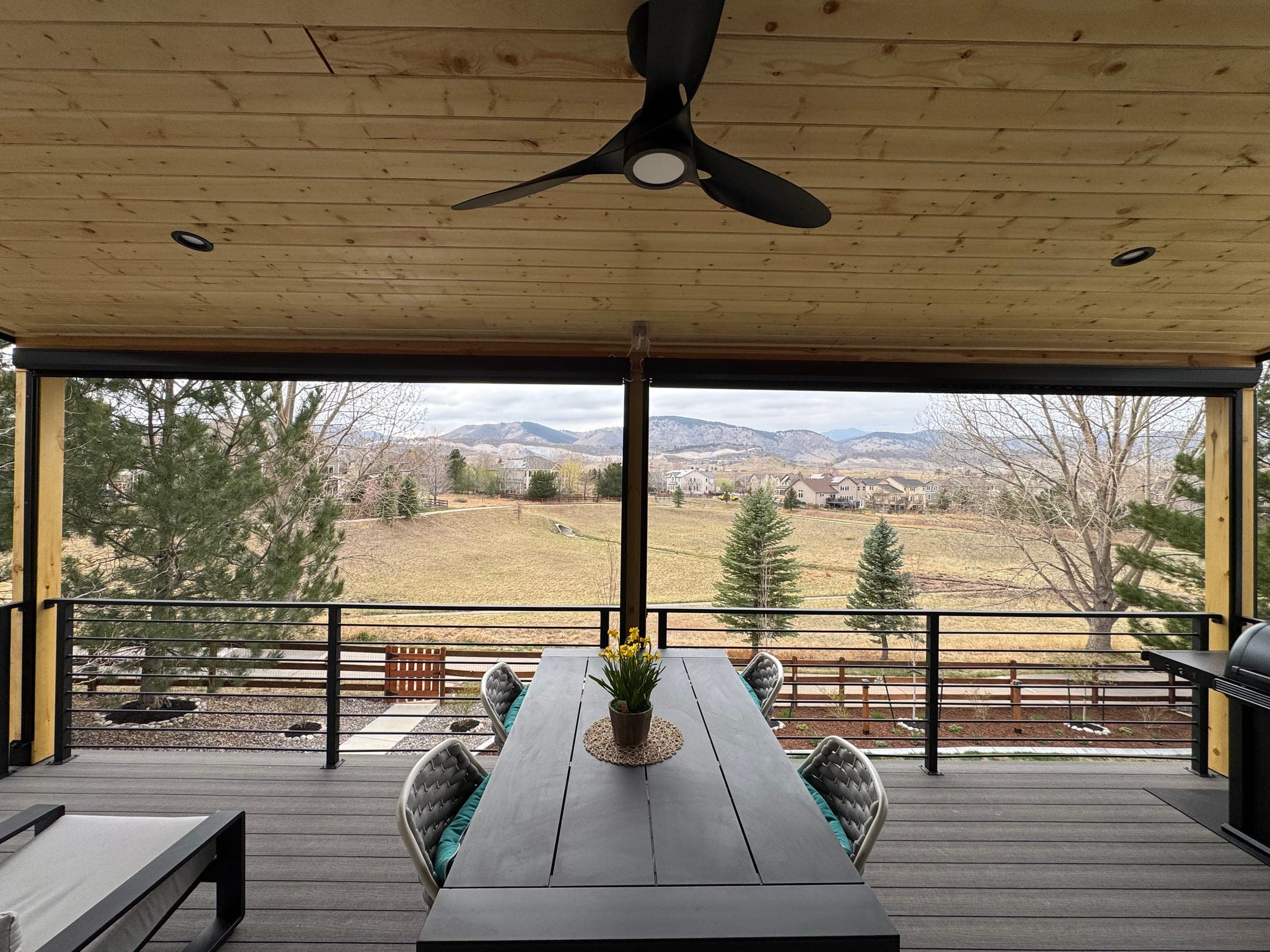
Decks here aren't suburban decks: bigger lots, custom houses, and a design brief that usually starts with a view across your own land. The landmark everyone shares is Castlewood Canyon State Park, 2,628 acres where Cherry Creek cut cliffs into the Castle Rock conglomerate.
Acreage changes the design
On five acres, a 12-by-16 platform looks lost. Franktown projects tend toward wraparounds, covered sections that hold up in wind and shade the afternoon side, and outdoor kitchens that make the deck the working center of the property. Horse owners usually want the sightline to the barn kept open, which slim aluminum or cable railing preserves.
Big lots also make freestanding structures practical: a detached covered room between house and barn, on its own footings, no ledger into the house. Douglas County's design criteria size the frame — in Franktown's elevation band (6,000–6,499 feet) the county requires a 35 psf roof snow load with no reductions allowed. Our covered deck cost guide shows what a roof adds.
At 6,200 feet the material math is familiar Colorado: hard UV, freeze-thaw cycling, and hail. Capped composite handles all three with soap and water; our materials comparison covers where wood still competes.
Building ember-aware in the ponderosa
There's a reason the Colorado State Forest Service keeps a field office in Franktown, at 2068 N. Highway 83: this is forested country where wildfire risk isn't abstract. In February 2026 a grass fire off Highway 83 near Lake Gulch Road ran 500 acres and evacuated 20 homes before responders contained it. A deck is one of the most ember-exposed parts of a house — embers land on the surface, drift into framing bays, and find whatever's stored underneath.
On wooded lots we build accordingly by default: ignition-resistant surfaces rather than untreated softwood, framing bays closed or screened, and an underside that isn't designed as storage. It doesn't make a deck fireproof, but it meaningfully cuts the liability. It also matches the county's own wildfire-mitigation guidance: Class A decking, gravel or a patio under the framing, nothing combustible stored underneath. Parcels the county maps in fire intensity classes 1 and 2 must also meet the 2025 Colorado Wildfire Resiliency Code at permit, so we check your parcel's class first.
Old decks on good houses
Plenty of Franktown homes carry decks that went up with the house decades ago. Before quoting, we inspect the structure — the ledger connection especially, because that's where aging decks fail expensively. Sound bones earn a re-deck in composite for far less than starting over; a finished frame gets a straight replacement recommendation. Our inspection guide shows what we check.
Deck repair in Franktown is the ranch-scale version of the same job: re-anchoring nailed ledgers, replacing posts set in soil instead of on footings, rebuilding stairs that run to grade. Our deck repair cost guide puts numbers on each.
One permit counter, handled
Franktown is unincorporated, so permits are unambiguous: the Douglas County Building Division in Castle Rock, reviewing to the 2024 IRC with the county's own amendments (the current set took effect July 1, 2026). The deck submittal is specific — scaled plans, a site plan with dimensions to property lines and any egress window wells under the deck, framing plans, stair and railing details, and the decking material — and the county recommends HOA or ACC approval before you apply. Footings go below county frost depth — the county's design criteria call for at least 36 inches below finished grade — and the structural package goes through county review. We prepare, file, and manage inspections through sign-off — the same process we run constantly in Castle Rock and Parker. The permit guide covers the general background.
Twenty minutes from the shop
Franktown sits about twenty minutes from our Centennial headquarters — close enough that this is home territory, with the same guarantee behind every build.
Run the numbers first if you'd like: the cost calculator gives you a real planning range, then tell us what you're planning.