
Where the county starts to climb
Sedalia is a small unincorporated community of a few hundred people at about 5,840 feet, sitting where Highway 67 leaves the Plum Creek valley and heads up Jarre Canyon toward the Pike National Forest. The housing that surrounds it is what brings us here: rural acreage and ranchettes along Highway 67 and Perry Park Road, a mix of older farmhouses, 1970s–90s custom homes, and newer foothills builds on sloped, pine-covered lots that climb toward the Divide.
One permit counter: Douglas County
There is no town hall in Sedalia and no municipal building department. The Douglas County Building Division in Castle Rock issues every deck permit here, the same counter we file with for Franktown and Roxborough Park and most Larkspur addresses. The county publishes a Deck Submittal Requirements Checklist and a Residential Deck Detail, and it makes two things clear up front: where a covenant applies, get HOA or architectural committee approval before applying, and the owner must verify utility and easement locations before excavation. On acreage that can mean a well line or septic field — something to know before a footing auger shows up.
We confirm your parcel, prepare one clean packet, and run inspections through final. Background in our permit guide, and the county hub for everything else at Douglas County.
Snow by the foot, footings by the frost
Douglas County tiers design snow load by elevation, and Sedalia spans three tiers. The townsite sits in the 30 psf band (5,152–5,999 feet); lots between 6,000 and 6,499 feet carry 35 psf; and above 6,500 feet the figure is 40 psf. Ground load equals roof load, with no reductions. That number sizes every beam and post under a covered deck or pergola, so we check the parcel's elevation before drawing anything. Frost depth is a 36-inch minimum countywide, which sets the footings. An older deck framed to the wrong tier is the most common thing we find on inspection.
Built for acreage and slope
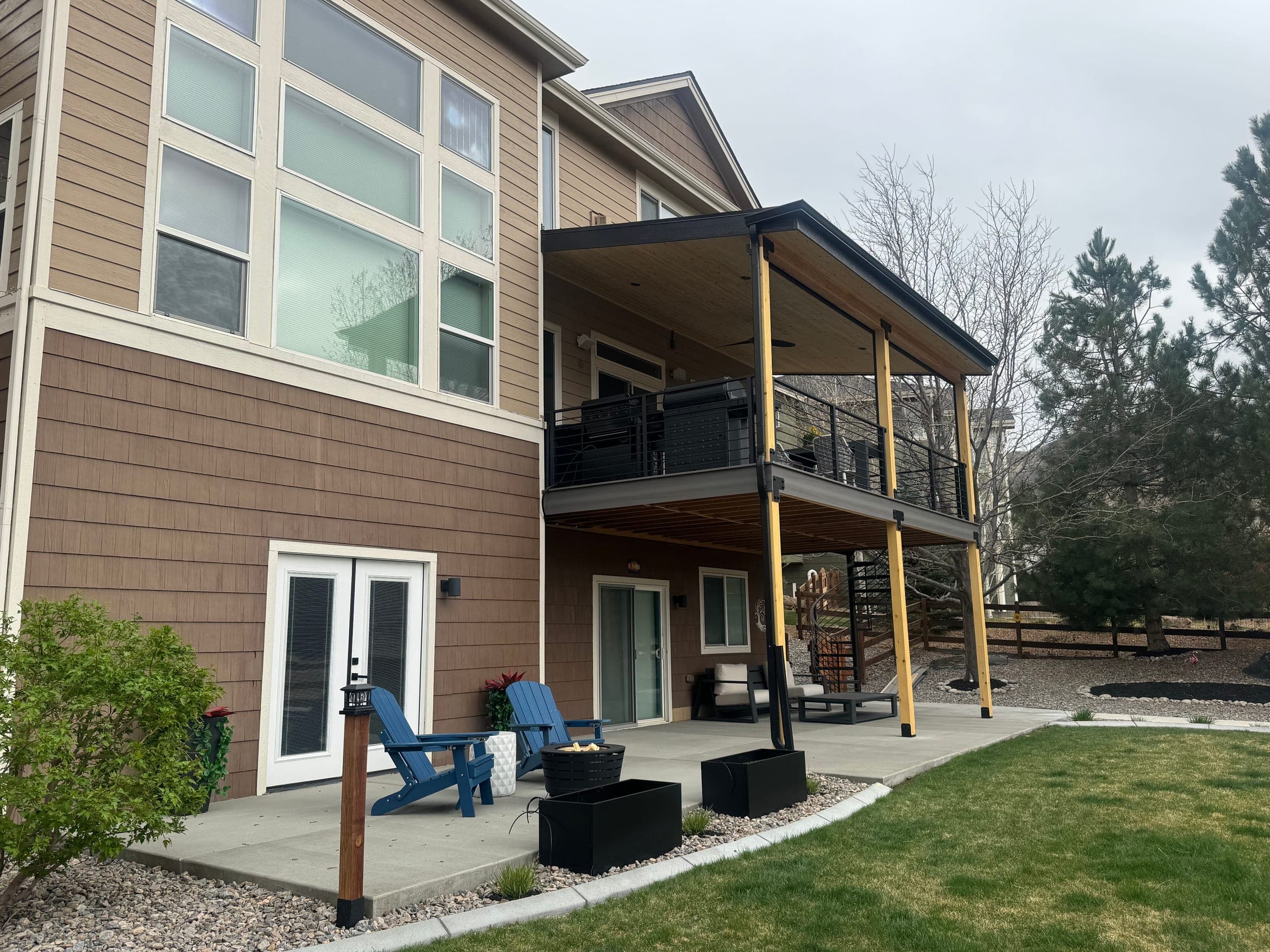
Acreage decks are bigger, lower, and more connected to the land than suburban ones: wraparounds, covered sections that stretch the season, railing chosen to keep the pines and the canyon in view rather than fence them off. On the sloped lots up toward the forest, the structure below the deck is where the budget goes — taller posts, stepped footings, and an underside we keep clear of stored fuel.
We lead with capped composite because this climate — altitude UV, freeze-thaw, heavy spring snow, summer hail — chews through bare wood fast. Where cedar or hardwood still makes sense, we say so.
Older decks, straight answers
Sedalia's housing spans decades, and many older decks were framed before the current snow tiers and hardware standards. We inspect the frame before quoting. Sound structure earns a re-deck in composite for a fraction of a rebuild; an undersized or failing frame gets a replacement recommendation on current-code structure. The inspection is free, and so is the verdict.
Thirty-five minutes down the highway
Sedalia is about thirty-five minutes from our shop in Centennial, a routine run just past Castle Rock. The drive shapes scheduling, not price or the warranty — those stay the same everywhere we build.
Run the cost calculator for a planning range, then tell us what you are planning and we will come walk the site.