
Eight thousand feet above Barker Reservoir
Nederland sits at 8,236 feet where Boulder Canyon opens onto Barker Reservoir — a compact downtown of mining-era buildings, and around it 1960s–80s cabins and A-frames on steep forested lots in Big Springs, along the canyon, and up toward Caribou Ridge. Lodgepole and ponderosa surround nearly every parcel. The elevation is the design brief: snow that stacks for months, freeze-thaw that works every fastener, UV that strips a wood finish in a couple of seasons. A deck built to a Denver-suburb detail does not belong up here.
Town permits, county rules next door
Inside town limits, the Town of Nederland Building, Planning & Zoning Department issues the permit from Town Hall at 45 W. First St. Applications are submitted electronically, and SAFEbuilt Colorado handles both plan review and inspections — inspections run Tuesdays and Thursdays, requested by 4 p.m. the day before. Eldora and the unincorporated forest around town answer to a different counter, Boulder County Community Planning & Permitting. We confirm the jurisdiction from your parcel, prepare the packet the reviewer actually wants, and manage inspections.
Snow load is the structural number
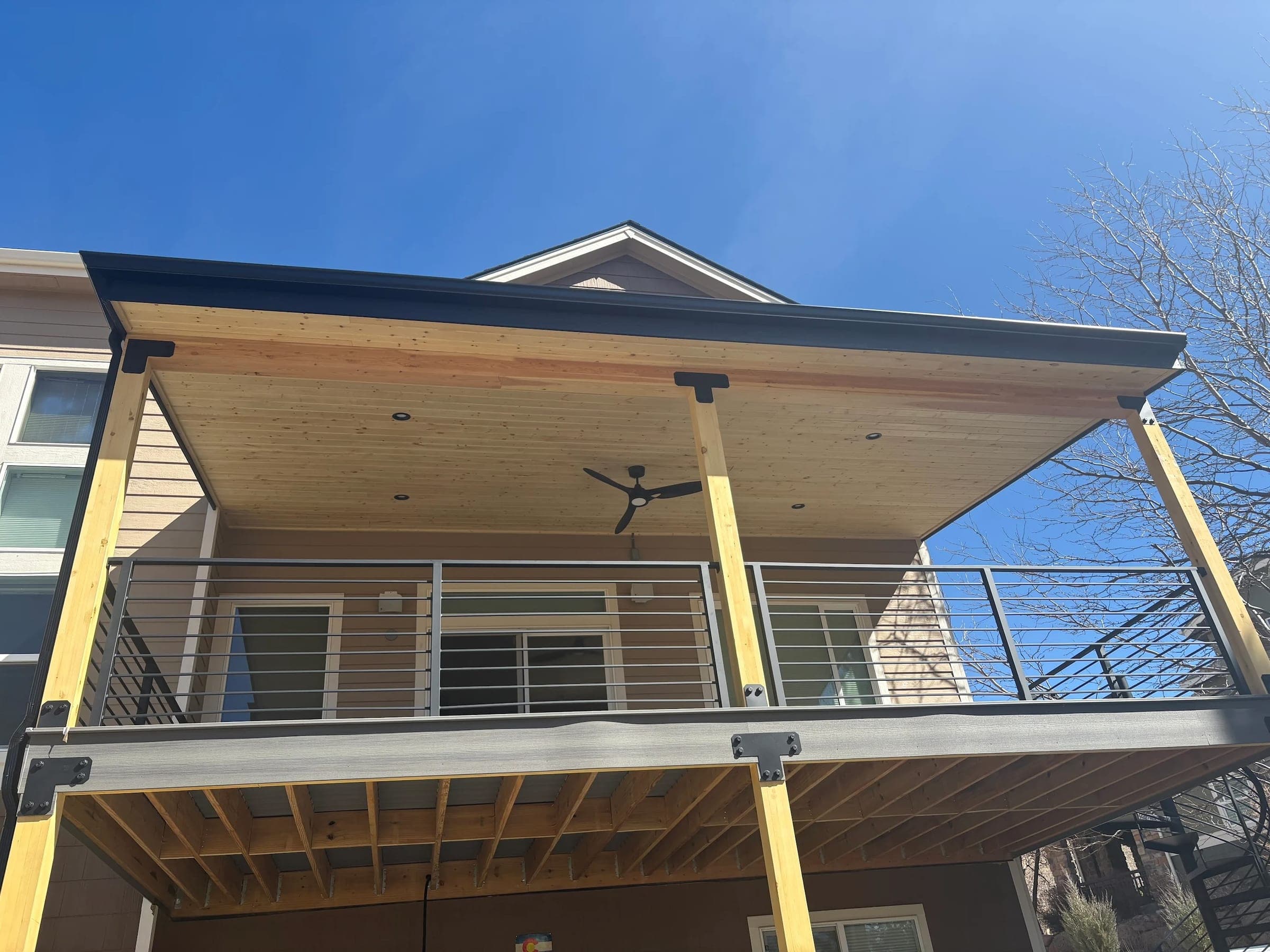
Boulder County's ground snow load map puts the Nederland-area mountains in its 75–100 psf bands — nearly double the 55 psf on the plains — and the site-specific figure is confirmed at plan review. That number sizes every beam, post, and footing, and it decides what a covered deck or patio cover has to carry as a roof. Footings go below the 30–36 inch frost line. This is engineering, not a rule of thumb: a Nederland covered section carries more lumber and steel than the same footprint in the metro.
Ignition-resistant is the assumption
Nederland is in the Peak-to-Peak wildfire zone. Boulder County's Section R390 rules govern the unincorporated land around town, and Colorado's statewide Wildfire Resiliency Code took effect in adopting jurisdictions on July 1, 2026 — so we treat ignition-resistant decking as the baseline on every Nederland parcel. That means capped composite or mineral-based boards instead of untreated softwood, framing bays closed or screened against embers, and an underside that is not a woodpile. We built this way before it was required; here the code and the forest agree.
Steep lots, real structure
Big Springs and canyon lots are steep and rocky, and the buildable envelope is often smaller than the acreage suggests. Elevated walkout decks are often the best square footage on the property, with the budget weighted toward the posts and footings below. We design from the grade, and choose railing in slim aluminum or cable that keeps the trees and the reservoir in view.
Repair versus replace, at altitude
Cabin-era decks here were built to snow and hardware standards a reviewer wouldn't accept today. We inspect the frame and answer straight: sound structure earns a re-deck in ignition-resistant composite; aged-out structure gets a replacement plan. The answer comes in writing either way.
Seventy-five minutes, honestly
From our shop in Centennial, Nederland is about seventy-five minutes up Boulder Canyon — past our Boulder work and near our range's far edge. The drive shapes scheduling, not price or the guarantee. Mountain builds reward timing too: fall contracts for spring builds are how the smart ones go, and NedFest weekend in late August is the one time we wouldn't park a trailer downtown.
Run the cost calculator for a planning range, then tell us what you are planning.