
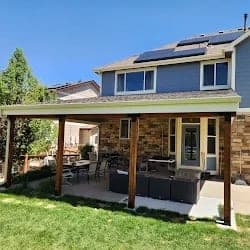
A railroad hamlet on the Peak to Peak
Rollinsville sits at 8,474 feet on the Peak to Peak Highway, between Nederland to the north and Black Hawk to the south, just below the east portal of the Moffat Tunnel. The townsite along Highway 119 is a cluster of older frame homes and cabins; around it, mountain homes sit on multi-acre forested lots along South Boulder Creek and up the Tolland and East Portal road. The county is drafting a Rollinsville Area Specific Plan, with public meetings in October 2026, but for a deck the facts are already set: altitude, forest, snow, and a county that engineers everything.
Permits: Gilpin County, through OpenGov
Rollinsville is unincorporated, so Gilpin County Community Development's Building Division issues the permit through the county's OpenGov portal. Attached decks require a permit, and any change to posts, beams, joists, guards, or stairs on an existing deck is permitted work too. Inspections run Mondays and Wednesdays. Timing matters more here than in the metro: applications filed after September 1 may not be approved before frost conditions, so we push Rollinsville contracts toward spring and summer submittals. We prepare the packet, file it, and manage inspections through final.
No single snow-load number — engineered, every time
Gilpin County does not publish one snow-load figure. It publishes a Snow Loads of Gilpin County GIS layer, updated November 2024, and requires an ASCE Hazard Tool report at Risk Category II plus site-specific snow and wind design on every structural permit. Prescriptive deck tables generally do not qualify; the county's own language is that a licensed structural engineer is almost always required. We pull the value for your parcel from the county layer, have the structure engineered to it, and design any covered deck or patio cover as the roof it is.
The wildfire code applies here
Gilpin County has adopted the 2024 International Wildland-Urban Interface Code with local amendments and the 2025 Colorado Wildfire Resiliency Code, aimed at forested lots like these along South Boulder Creek. Sprinklers are required for dwellings over 3,600 square feet and in the county's Extreme Building Exposure Areas. For a deck, the practical upshot is capped composite or mineral-based boards instead of untreated softwood, framing bays closed or screened against embers, and an underside that is not a woodpile. We confirm the exposure-area mapping with the county before every build.
Multi-acre lots, real structure
Rollinsville acreage runs to slope and rock, so the flattest ground is often an elevated deck off the back of the cabin, with the budget's weight in the posts and footings below. We design from the actual grade, and choose slim aluminum or cable railing that keeps the creek and the trees in view.
Repair versus replace
Cabin-era decks here were built to assumptions a county reviewer would not accept today. We inspect the frame and answer plainly: sound structure earns a re-deck in ignition-resistant composite; aged-out structure gets a replacement plan on engineered framing. Either way the answer comes in writing, and either way the county wants to see it.
Eighty minutes, scheduled in blocks
From our Centennial shop, Rollinsville is about eighty minutes — up I-70 and US-6 through Golden and Clear Creek Canyon, then north on the Peak to Peak. We schedule mountain builds in consecutive-day blocks, which keeps the drive out of your price while keeping the same guarantee as in the metro.
Run the cost calculator for a planning range, then tell us what you are planning — we will bring the snow-load value and the permit timeline for your parcel.