
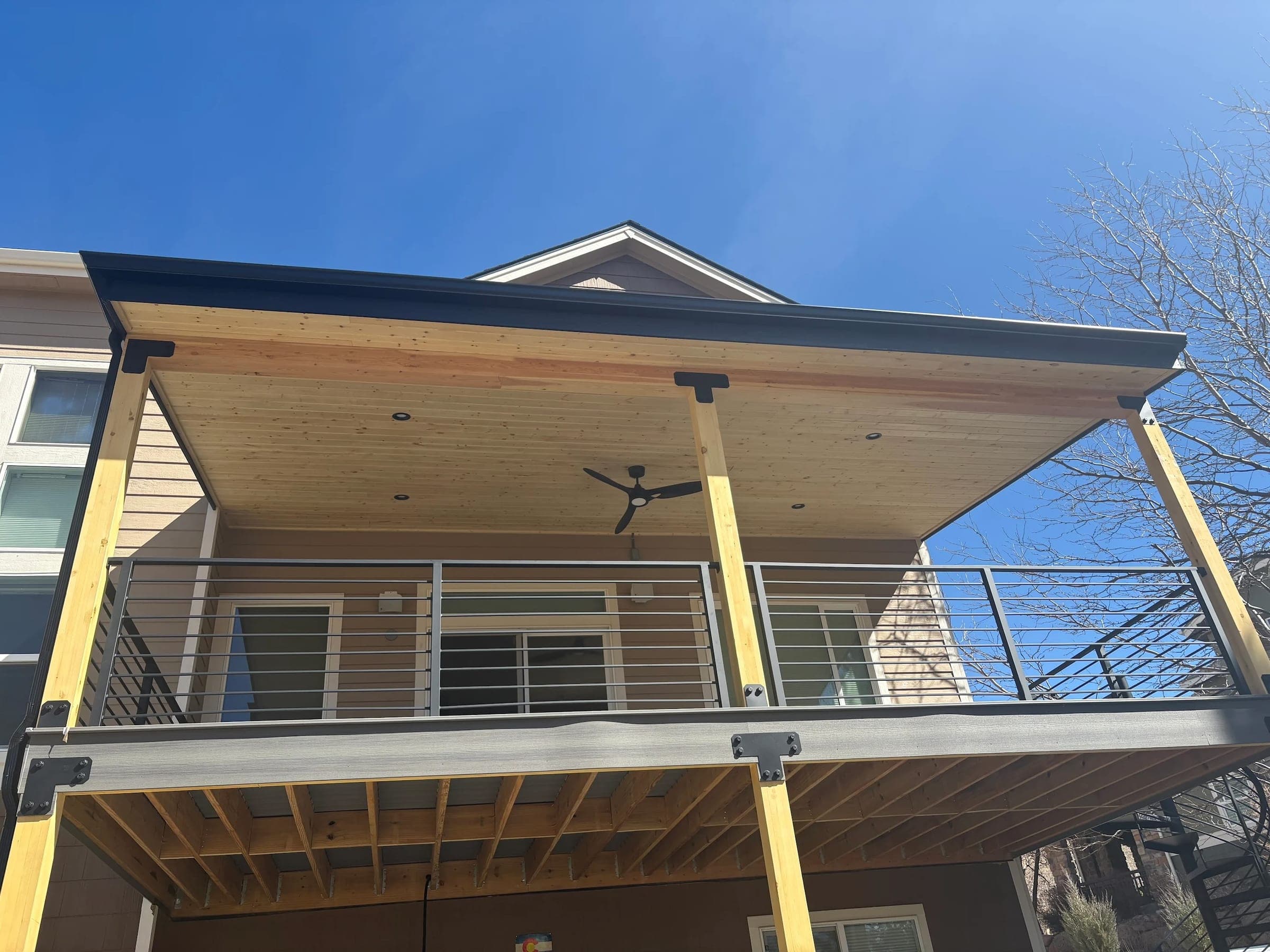
The wind is the headline
Most Colorado towns design for snow; Estes Park designs for wind first. The town sits in a designated ASCE 7 special wind region for Front Range downslope windstorms — the Chinook events that pour off the Divide — and Larimer County requires design wind speeds taken from the SEAC Front Range Gust Map, with values from 115 mph up to 225 mph depending on the site.
The practical consequence: prescriptive deck design under the IRC is only permitted below 140 mph ultimate wind and 70 psf ground snow. Many Estes lots map above that line, which means an engineered deck — calculated connections, uplift hardware, footings sized for the site — is a code requirement, not an upsell. We build that engineering in from the first drawing.
Snow, altitude, and the surface that survives both
At 7,522 feet, the county's minimum design roof snow load of 35 psf governs every covered structure, and framing under an open deck is sized for real mountain snow, not metro snow. The surface takes the altitude's UV and freeze-thaw too, which is why we lead with capped composite instead of wood's yearly refinishing — our materials comparison is candid about the trade-offs.
The resident elk herd leans on, rubs against, and walks through landscaping and railings, so we spec railing systems with that abuse in mind — sturdy posts, no fragile infill at ground level — while keeping the sightlines that steep view lots exist for.
Cabins, customs, and rental math
Estes housing runs from mid-century cabins in neighborhoods like Carriage Hills to custom mountain homes in Fall River Estates and Stanley Heights, with a heavy short-term-rental presence throughout. For rental owners, the deck is often the listing photo, and low-maintenance composite matters when the property earns between cleanings.
For the older cabin stock, we inspect the frame before quoting, per our inspection guide: sound framing earns a re-deck for far less than a teardown, while frames that predate today's wind and snow criteria get an honest replacement recommendation.
Fire is part of the design brief
The full-town evacuation during the October 2020 East Troublesome Fire confirmed Estes Park is wildland-urban interface. On these lots we default to ignition-resistant surfaces, screened framing bays so embers can't nest under the deck, and an underside that isn't storage — not fireproof, just less of a liability on the worst day.
Permits in town and in the valley
Inside town limits, the Town of Estes Park's Division of Building Safety issues the permit; unincorporated Estes Valley properties go through Larimer County, and electrical permits run through the state. We handle the drawings, the engineering package, the filing, and inspections through sign-off.
Honest about the distance
Estes Park is roughly an hour and forty-five minutes from our Centennial shop, past our Longmont and Loveland service areas. We take a limited number of Estes builds and schedule them in blocks so crews work efficiently rather than commuting daily. The warranty is identical to every build we do.
Start with the cost calculator for a planning range, then tell us what you're planning — early, if you want a mountain slot this season.