
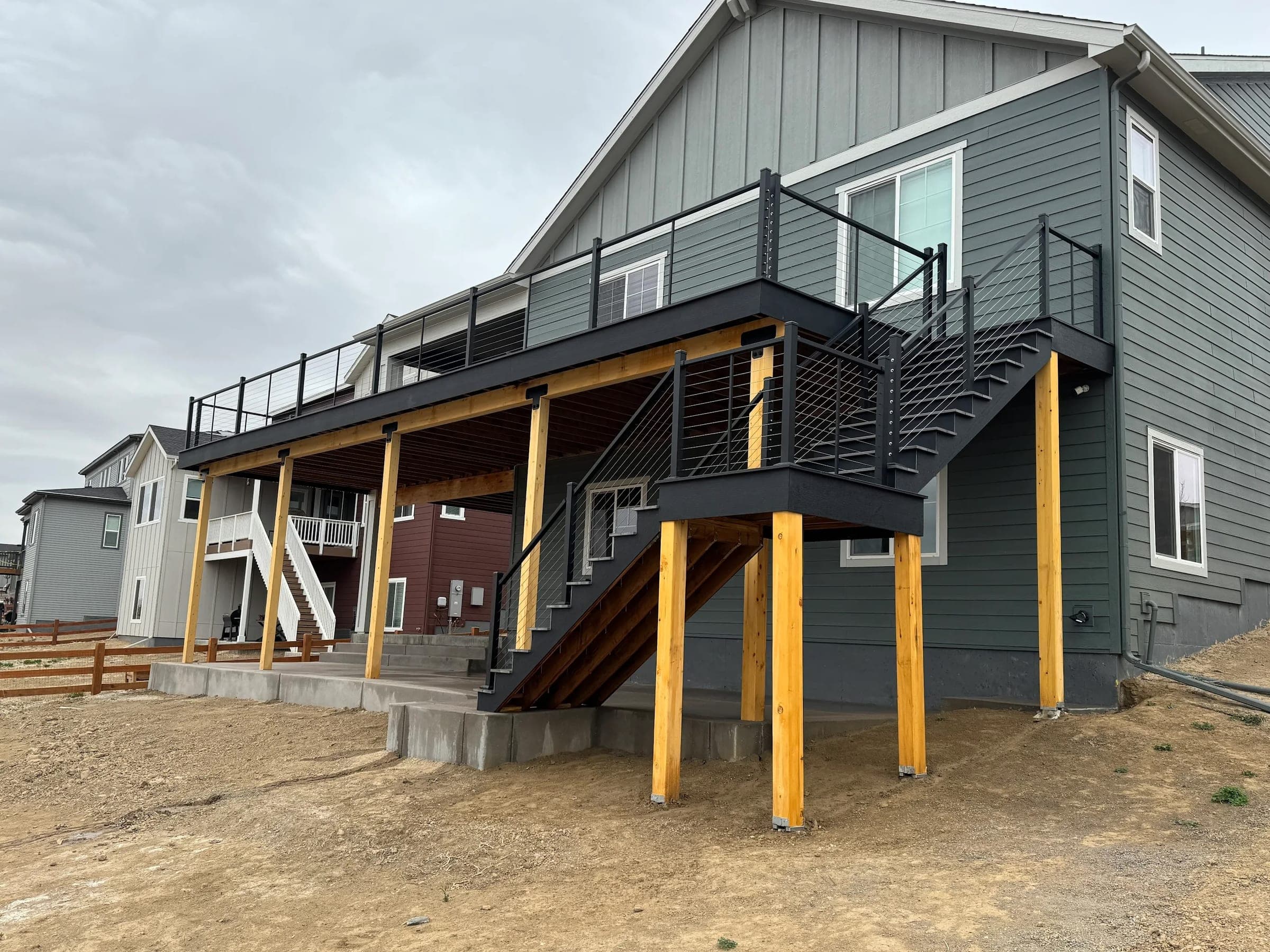
Big sky, no shade
Peyton itself is a crossroads of a few hundred people on the plains east of Colorado Springs, though the Peyton ZIP covers far more: the fast-growing Falcon area, with Meridian Ranch, Woodmen Hills, and Paint Brush Hills full of 2000s–2020s production homes, plus 5-acre ranchettes out toward the Black Forest edge. The lots are flat, windy, and treeless, with expansive soils underneath and a horizon in every direction. Unlike our Ute Pass work a half hour west, where the deck fights a slope or a snowbank, here it fights the wind and the sun.
Permits: one regional counter, plus the HOA
Peyton and Falcon are unincorporated El Paso County, so there is no town hall. The Pikes Peak Regional Building Department issues the building permit, the same counter that serves Colorado Springs and Monument, and El Paso County Planning and Community Development handles setback and site questions. Decks are permit-required, and PPRBD's homeowner permits are limited to owner-occupied primary residences, so the licensed contractor pulls it. Many Falcon subdivisions — Meridian Ranch and Woodmen Hills among them — layer HOA design review on top, and we complete that before the permit goes in.
Wind first, then snow
At about 6,801 feet Peyton is below the 7,000-foot line, so PPRBD's design criteria are 43 psf ground snow and 30 psf flat-roof snow — real, but not the mountain tier. The number that drives the engineering here is wind. With no tree cover, a patio cover or pergola takes the full force of it, and uplift will pull an under-anchored roof apart. We engineer covered structures for uplift as well as gravity, tie them into properly sized footings, and set those footings below the 30–36 inch frost line. A roof built that way costs more than a catalog kit — and it's still standing after the next windstorm.
Composite, for a lot with no shade
Full-sun exposure, Front Range hail, and daily freeze-thaw: wood finishes fail fast out here, and the staining schedule becomes the deck's real cost. Capped composite handles UV and hail with soap and water, which is why we lead with it. Wood still has a place where you want the grain and accept the upkeep; out here, most owners do not. A slim aluminum or cable railing keeps that view open.
Builder decks: repair or replace
Most decks around Falcon are builder-grade wood on production homes: the frame is often fine and the surface is not. We inspect first. A sound ledger, posts, and footings earn a re-deck in composite at $20–$35 per square foot; heaved footings or a minimum-spec frame that never suited this wind get a replacement in writing. Either way you get both numbers, with photos of what we found under the boards.
Seventy-five minutes, in blocks
From our shop in Centennial, Peyton is about seventy-five minutes — I-25 south, then east across the north side of the Springs. We schedule the Pikes Peak region in blocks, batching site visits and build days rather than making one-off trips. Price and the warranty are the same; lead time is what the drive affects. Run the cost calculator for a planning range, then tell us what you are planning.