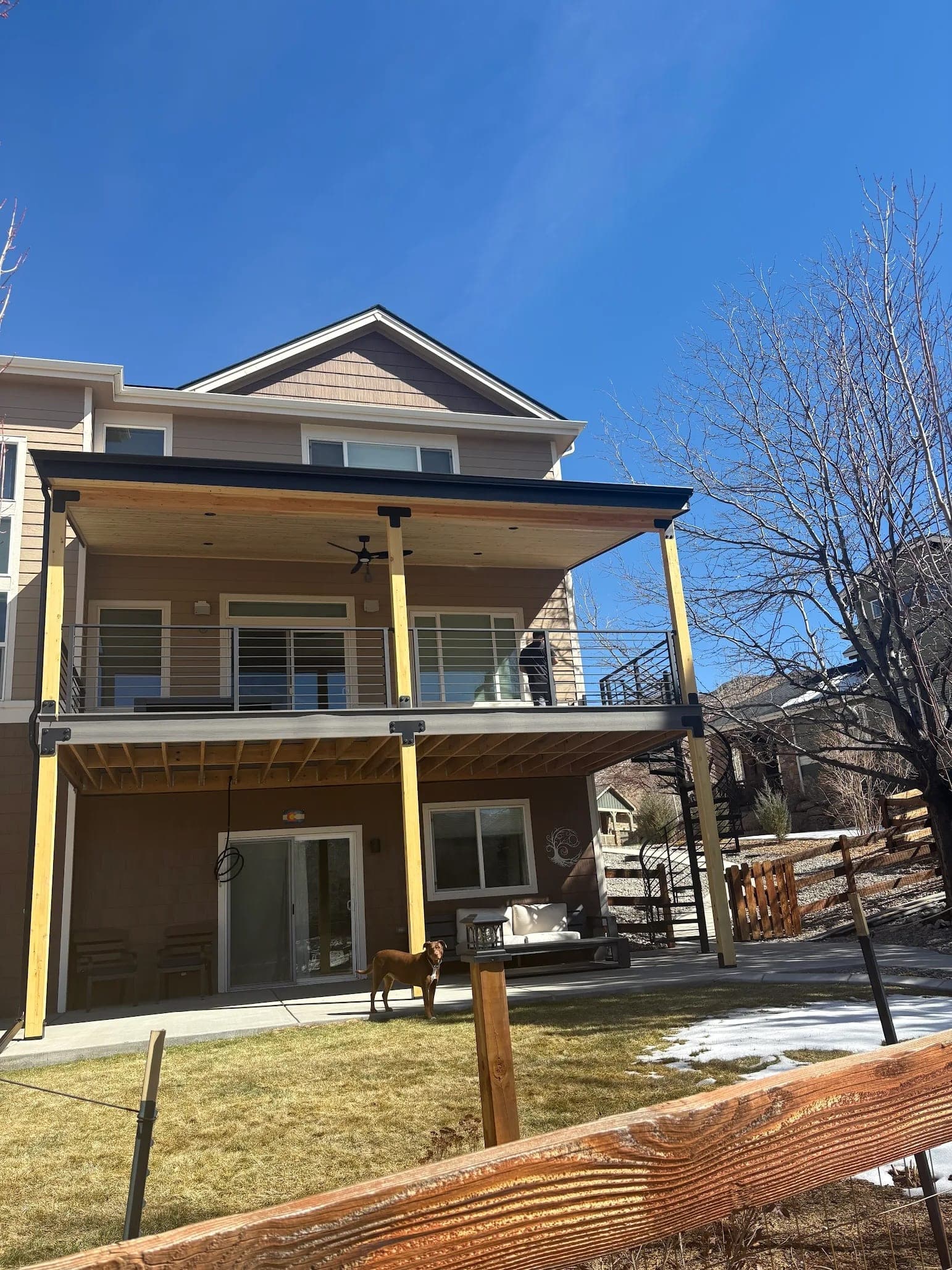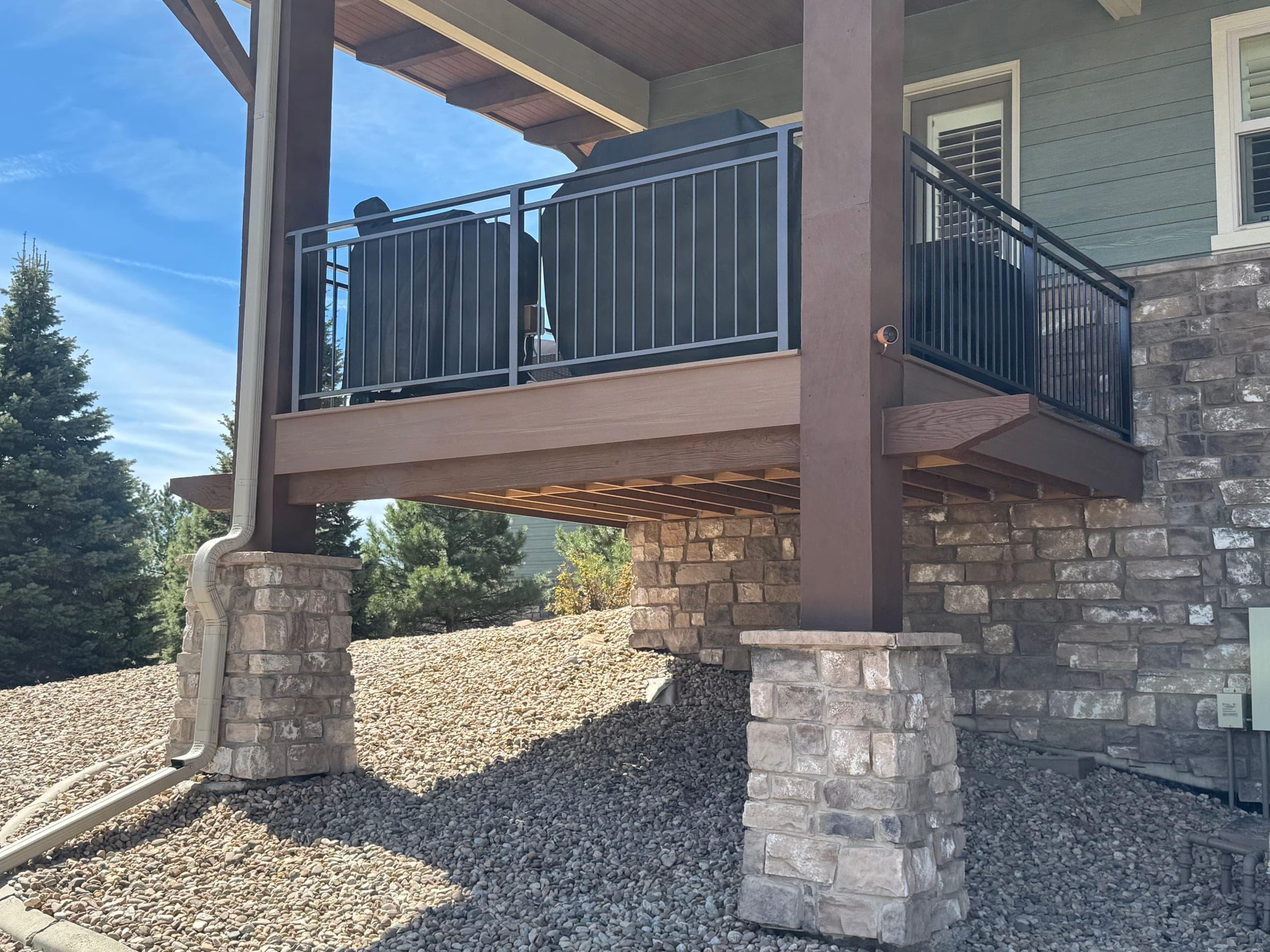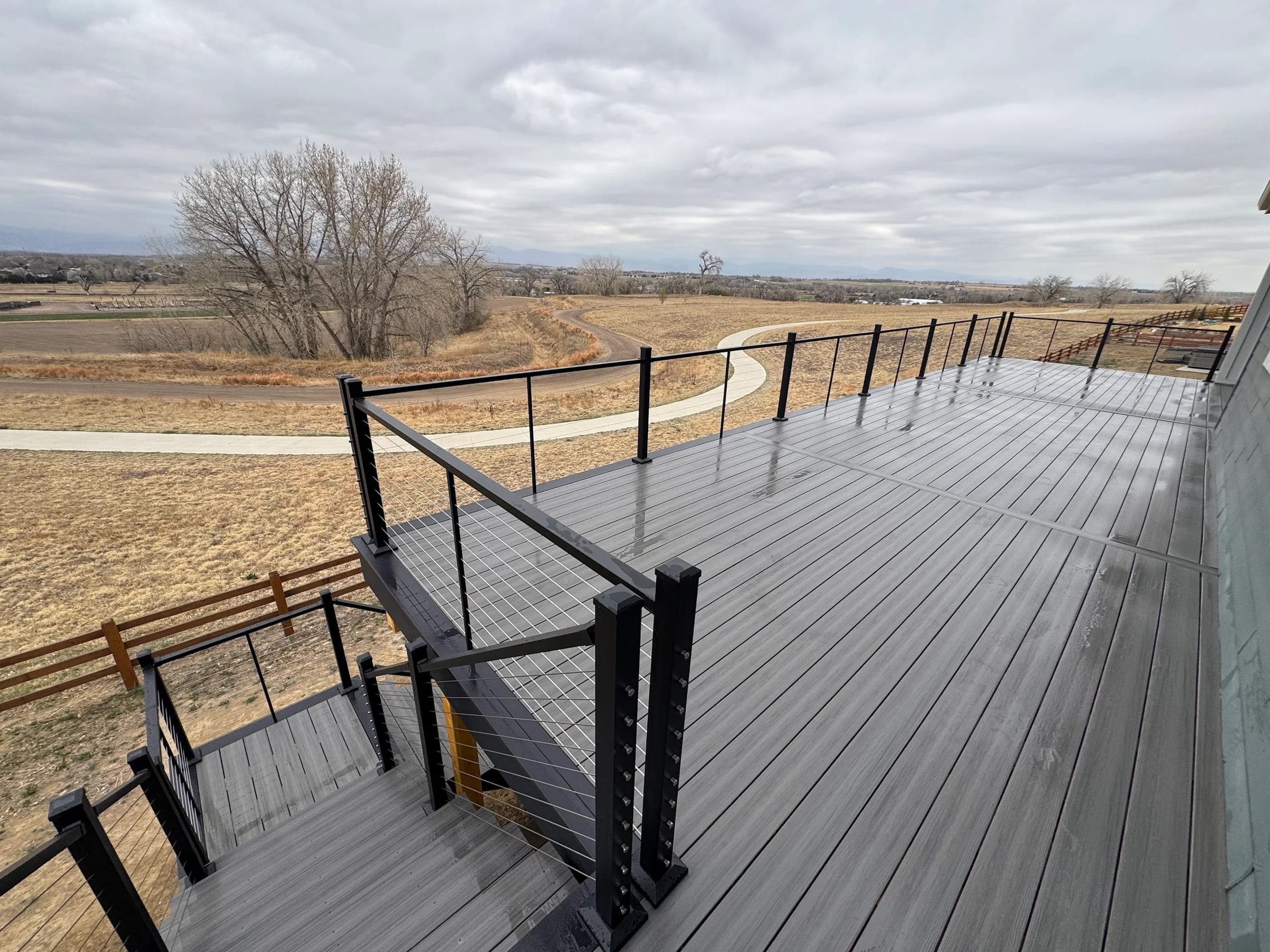
Capped composite decking realistically lasts 25–30 years in the Denver area — ahead of pressure-treated pine (10–15 years) and cedar (15–20 years) under our UV and freeze-thaw. But the board is rarely what fails first. Underneath nearly every composite deck is pressure-treated framing, and untaped joist tops can start rotting in 10–15 years — which is why a strip of joist tape over every joist matters as much as the brand of board on top.
"How long will this deck last" almost always means "how long will the boards last" — the wrong question. The boards and the frame age on two different clocks, and in Colorado, the frame's clock usually runs out first.
How long does composite decking actually last?
In the Denver metro's UV and freeze-thaw, that spread holds — with PVC and mineral-based composite stretching further still, to 30–50 years. Our composite vs. wood decking guide has the full breakdown by material, including cost.
Those composite numbers assume a modern, capped board — a polymer shell wrapped around a wood-plastic or PVC core — installed to spec. Warranty paper runs even longer on paper (more below), but "warrantied" isn't "realistically good-looking and sound," especially once proration kicks in after a decade or two.
Is it the boards or the frame that gives out first?
In the vast majority of composite decks we inspect, it's the frame. Composite boards sit on joists and beams that are almost always pressure-treated lumber, with its own shorter clock — industry data consistently points to rot showing up at joist tops within 10–15 years when that top edge isn't protected, where water from the board gaps lands and is slow to dry.
That's the whole case for joist tape: a strip of self-adhering flashing tape run over the top of every joist and beam before the decking goes down. It sheds water to the sides instead of letting it soak into the end grain and every screw hole, extending a frame's working life well past what bare treated lumber gets on its own. A deck with 30-year boards over untaped, unprotected framing is still a 15-year deck — the board warranty just doesn't apply to the part that failed. It's part of how we frame every job; see our composite decking page for the rest of the substructure spec.
How long does Trex decking last?
Trex's current decking, fascia, and cladding warranty (effective 2023) sets separate terms by line; fade-and-stain coverage matches structural coverage on every one:
| Trex line | Residential structural | Residential fade & stain |
|---|---|---|
| Enhance (Natural / Basics) | 25 years | 25 years |
| Select | 35 years | 35 years |
| Transcend / Transcend Lineage | 50 years | 50 years |
| Signature | 50 years | 50 years |
Commercial installs get a shorter term across the board: 10 years, regardless of line. We install Trex as a Trex Platinum Pro, which is what unlocks the longer labor-coverage tiers on top of the material warranty above.
What's TimberTech's lifespan — EDGE, PRO, and AZEK?
TimberTech grades its three product tiers the same way Trex does — longer warranty, higher price:
| TimberTech line | Residential structural | Residential fade & stain |
|---|---|---|
| EDGE | 25 years | 25 years |
| PRO | 30 years | 30 years |
| AZEK / Advanced PVC collections | Limited lifetime | 50 years |
AZEK's PVC boards carry no wood content, so the structural term jumps to lifetime — no wood fiber core to rot even if moisture gets underneath. Commercial applications run 10 years on EDGE and PRO, 20 years on AZEK. As an authorized TimberTech dealer, we build to the spec that keeps these terms intact.
And Fiberon?
Fiberon's current residential warranty also splits by collection: Good Life runs 25 years on its entry Weekender collection and 30 on the upgraded Escapes collection; ArmorGuard is the same 25-to-30-year split between its base and Pro versions; Sanctuary carries a flat 40 years; and Concordia (PE composite) and Paramount (PVC) both carry lifetime structural coverage with 50 years on fade and stain. Commercial installs across the lineup run 10 years.
On every brand above, that fade-and-stain coverage is conditioned on the deck being built to spec — Trex's warranty, for instance, is explicitly void for "improper installation... including but not limited to improper gapping," and excludes heat damage from sources over 275°F. Labor coverage is a separate, shorter clock tied to the installer's certification tier; the full brand-by-brand mechanics are in our plain-English warranty guide. For how the three brands stack up on heat, looks, and structure rather than just lifespan, see our installer's comparison of Trex, TimberTech, and Fiberon.
What actually shortens a composite deck's life?
A handful of things show up again and again on decks that don't make it to their warranty number, boards or frame:
- Uncapped, first-generation boards. Early wood-plastic composite from the 1990s and 2000s had no polymer cap, so it absorbed moisture like wood, then swelled, splintered, and grew mold years ahead of schedule. Every major brand's current line is capped to avoid this — an uncapped deck is already past due for a re-deck.
- Bad gapping. Composite expands and contracts with temperature more than wood does. Install it too tight and it can buckle in summer heat; too loose and it looks sloppy and traps debris. Every manufacturer publishes a gap spec, and getting it wrong is a named exclusion in Trex's warranty.
- Poor ventilation over low decks. A deck built close to grade with no airflow underneath traps moisture against the underside of the boards and the top of the frame. This is the scenario where AZEK's PVC, rated for tighter clearances, earns its premium over standard capped composite.
- Grills, fire features, and radiant heat. A composite cap can scorch or melt under sustained heat well below an open flame — manufacturer warranties draw the line around 275°F — so a grill needs a mat and clearance, not a spot straight on the boards.
- Failing framing. Back to the frame: rot at the ledger, soft joists, or undersized framing will take a good deck down early no matter what's screwed on top, and none of it is covered by a board warranty.
Plan for the frame, not just the boards
The board you pick decides the color and the warranty paperwork. What actually decides how long the deck lasts is what's underneath it — taped joists, correct gapping, enough airflow, and framing that was sound to begin with. Get a free estimate and we'll walk you through both halves before you pick a board.