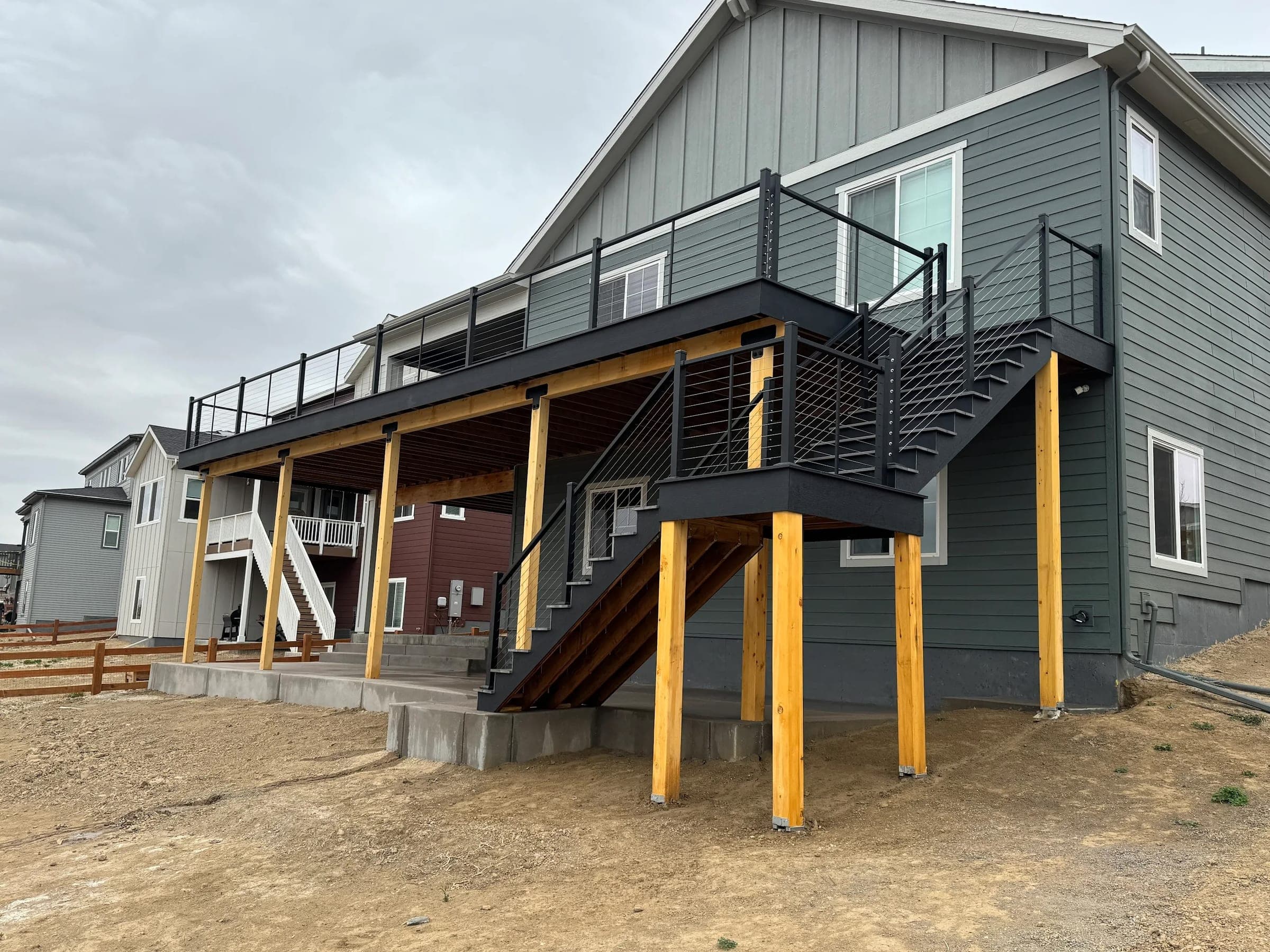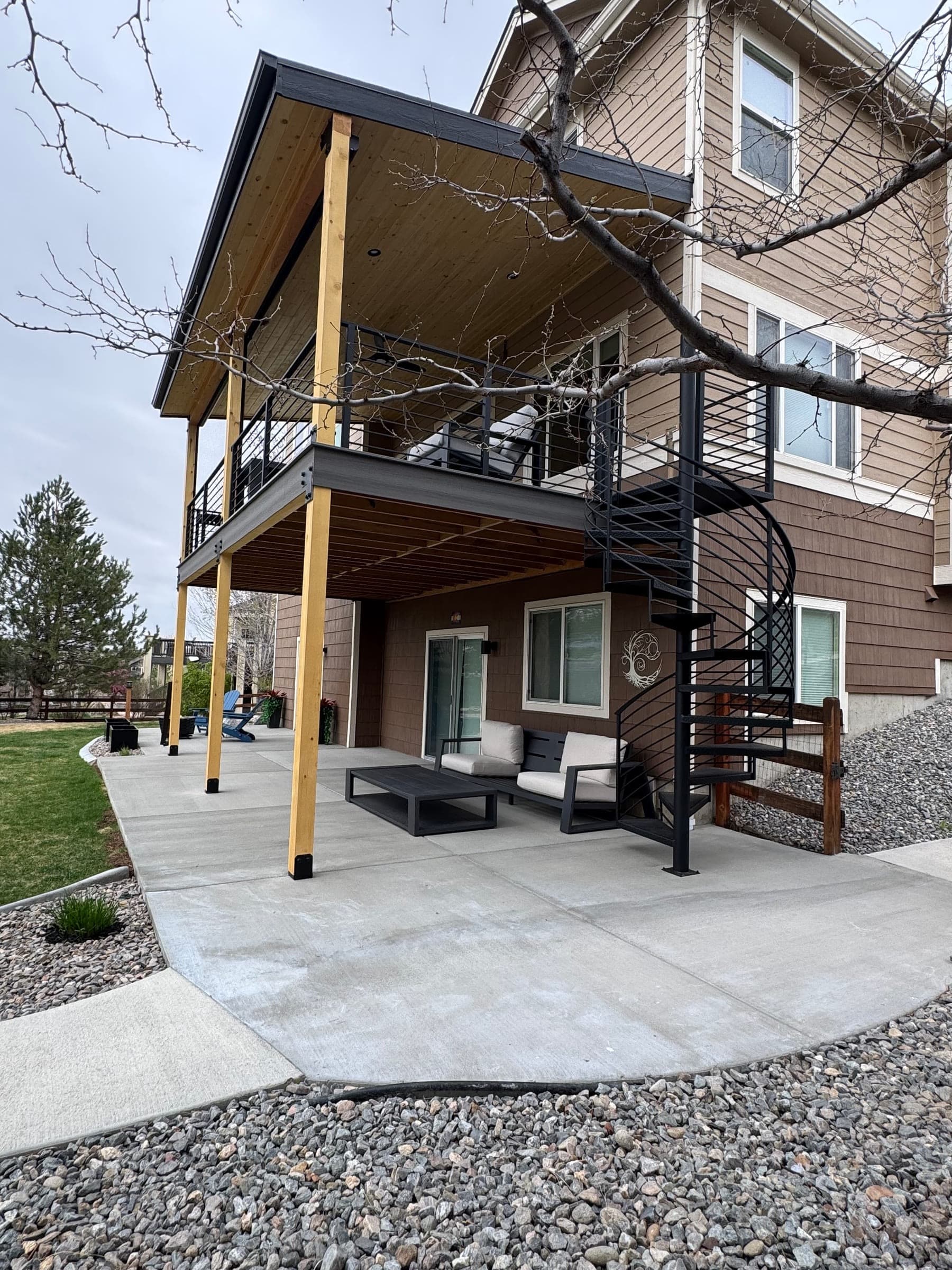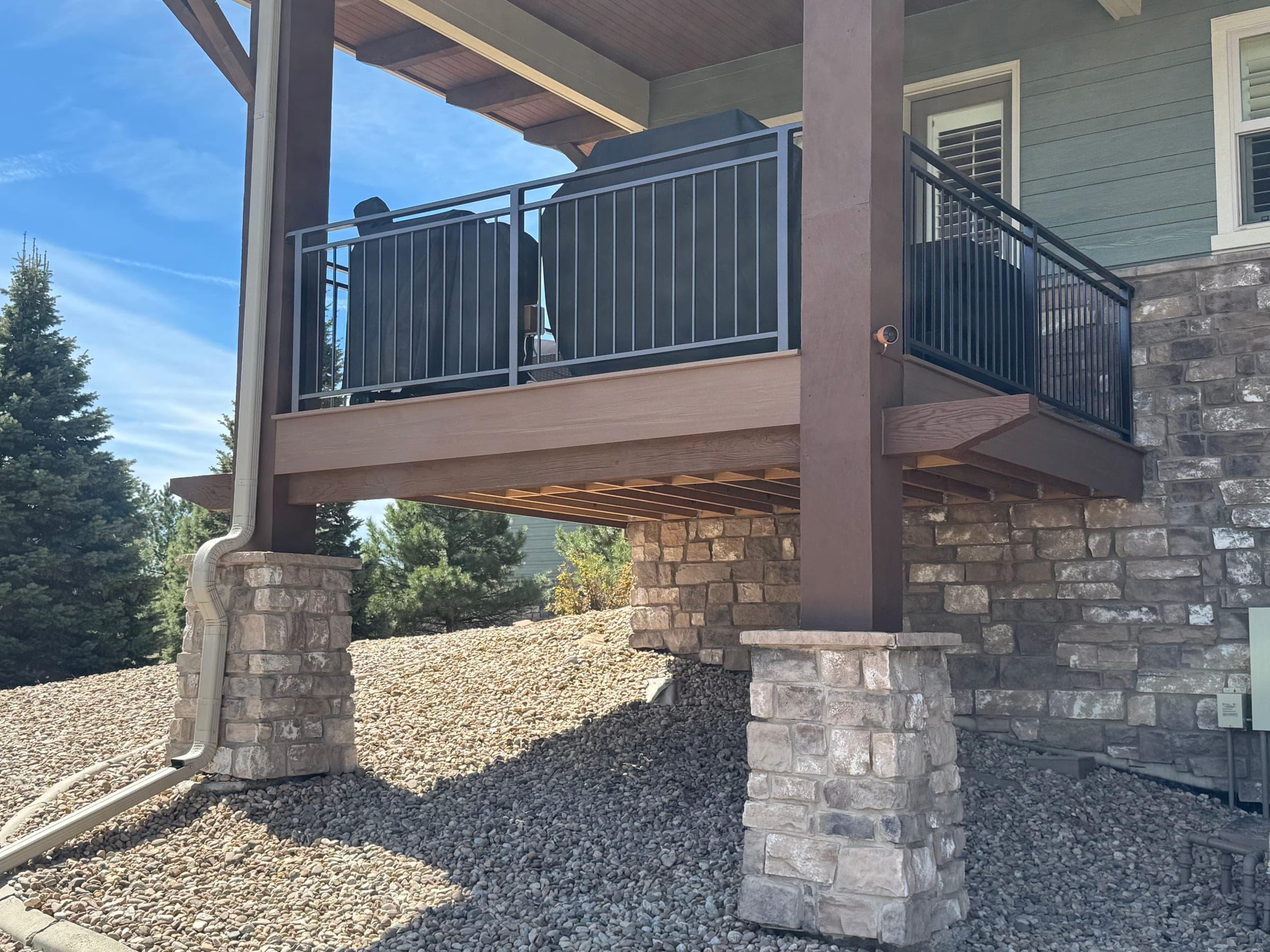
A deck post that's soft, crumbly, or losing its shape at the base is rotting because water is sitting against the wood there and never drying out — almost always from soil contact, a concrete collar that traps rainwater, or a missing standoff hardware. Replacing a post and footing together runs roughly $500–$1,200 in the Denver metro. The fix is often smaller than people fear — but a post that's lost real wood needs shoring before anyone touches it.
Why do deck posts rot at the base?
Four causes, usually at least two working together:
- Posts buried directly in soil. Wood in constant contact with soil wicks moisture nonstop. Even pressure-treated, ground-contact-rated lumber is only protected to a certain chemical depth — the protection wears thin at the surface, and decay starts from the outside in. The IRC requires this kind of ground-contact treatment for any wood embedded in soil or concrete that supports a structure.
- Posts set in a concrete collar. Pouring concrete around a post is often worse than soil. Concrete is porous and shaped like a cup — it catches rainwater and holds it against the grain longer than open ground, which is why "set in concrete" posts often rot exactly at the concrete line.
- A missing or failed post base. Code is specific: it calls for roughly a 1-inch standoff between the end grain of the post and concrete (or about 6 inches above exposed soil with a moisture barrier), so water physically can't bridge to the end grain. Hardware makers like Simpson Strong-Tie build standoff post bases around exactly that gap. A post set flush on a footing or toe-nailed to a buried pier with no standoff skips that protection.
- Frost heave. Colorado's freeze-thaw cycle moves the ground every winter. A footing poured too shallow lifts and settles unevenly, which can crack the footing, tip a post out of plumb, or open a gap at the base that collects water.
Surface rot or structural loss — how do you tell?
Use a screwdriver on all four faces and the end grain at the base, the same probe test used on deck boards and joists. Surface rot is confined to a thin outer shell — scrape away the soft layer and there's firm wood underneath. It's worth treating, not an emergency. Structural loss is when the blade sinks an inch or more with no resistance, the post visibly narrows compared to its neighbors, or you can wiggle it at the base — load-bearing wood is gone.
One rule either way: don't rock, bounce, or load-test a post you already suspect is bad. If it's the only thing holding that corner up, testing it is how it fails.
What should you check today?
| Check | What you're looking for |
|---|---|
| Base of every post | Soft, dark, or crumbly wood at or just below grade |
| Screwdriver probe, all sides + end grain | Blade sinks in easily, especially near the ground or concrete line |
| Plumb | A post leaning or out of square with its footing — possible heave or lost bearing |
| Standoff hardware | A visible gap between wood and concrete, versus a post sitting flush or buried |
| Grading around the post | Soil, mulch, or debris piled against the base, holding moisture there |
If you want the rest of the structure checked at the same time — ledger, framing, railings — our deck safety inspection guide covers the full ten-minute walkthrough.
How is it fixed, and what does it cost?
The fix depends on how much of the post is actually gone:
- Surface rot, sound core — clean out the soft wood, and if there's no standoff hardware, add one. This is the cheapest outcome and often rides along with a general hardware refresh.
- Structural loss at the base — the deck gets temporarily shored first, with jacks or temporary posts carrying the load off the damaged one, before any cutting starts. This isn't a step to improvise — getting the sequence wrong drops a corner of the deck.
- Post replacement on a sound footing — if the existing footing is intact and at depth, the rotted post is cut out and a new one set on an elevated standoff base, keeping it off the concrete.
- Full post-and-footing replacement — when the footing itself is undersized, cracked, or shallower than the local frost line, the old footing comes out and a new one is poured to depth, with a standoff base and new post set on top. The AWC's prescriptive deck guide requires footings to reach at least 12 inches below grade or below frost line, whichever is deeper — commonly 30–36 inches across the Denver metro, but confirmed with your building department.
Either version of post-and-footing work runs $500–$1,200 per post in the Denver metro in 2026. If more than one post is rotting at the same base condition, that usually means the whole footing generation was built shallow or without standoffs — worth a full inspection; see our repair service page for how that inspection works. And if the rot started above in the deck boards and tracked down through the framing to the post, our companion guide on soft spots in deck boards covers that end of the same problem.
Don't wait for it to pick the moment
A post that's rotting at the base doesn't announce itself until it's already lost real strength, and freeze-thaw works on it every winter. Schedule a free structural inspection and we'll probe every post, check the footings against code depth, and hand you a written verdict — surface treatment, a standoff base, or a full post-and-footing replacement — with a real number attached. The full price list for every common repair is in our deck repair cost guide.