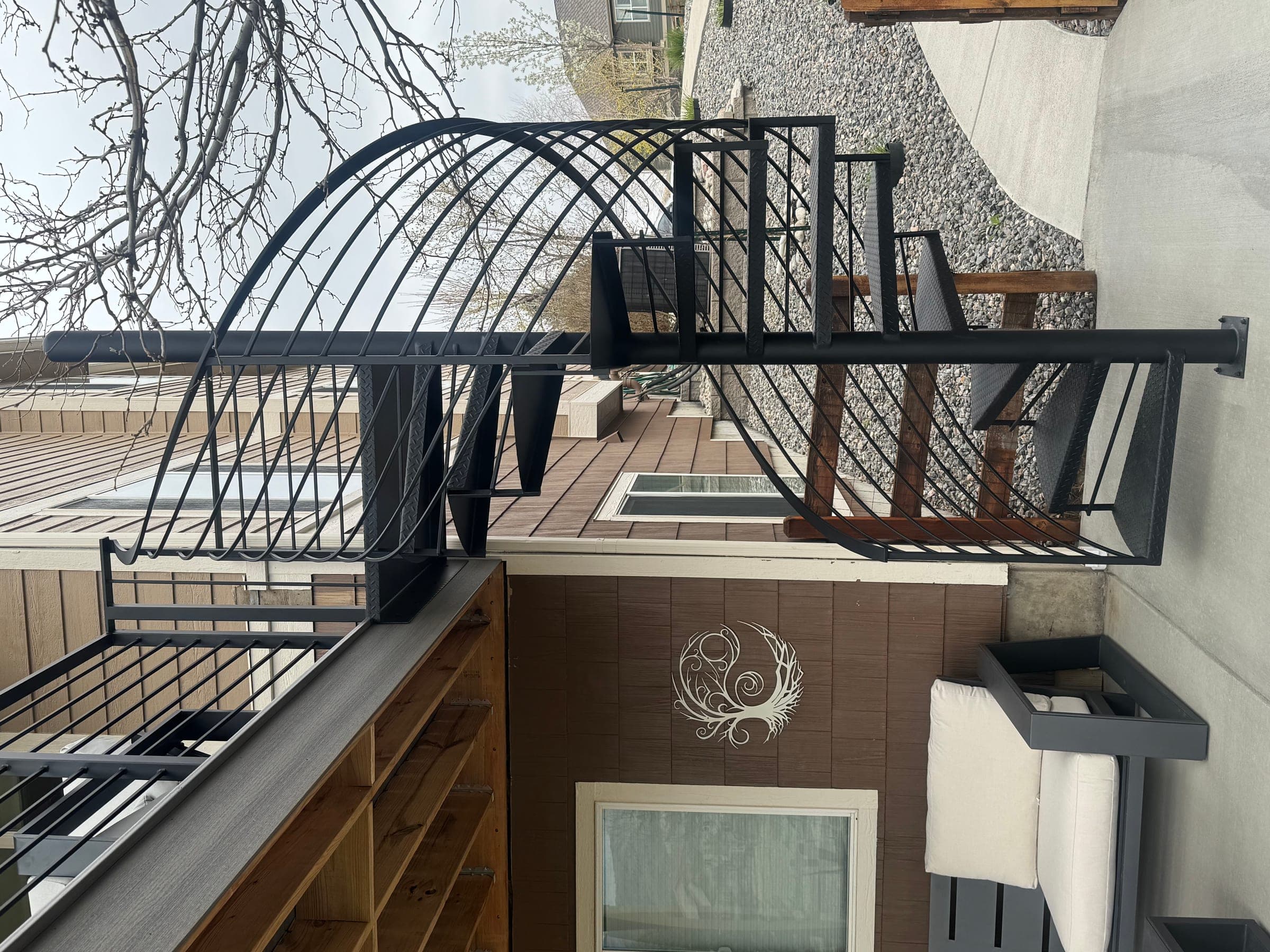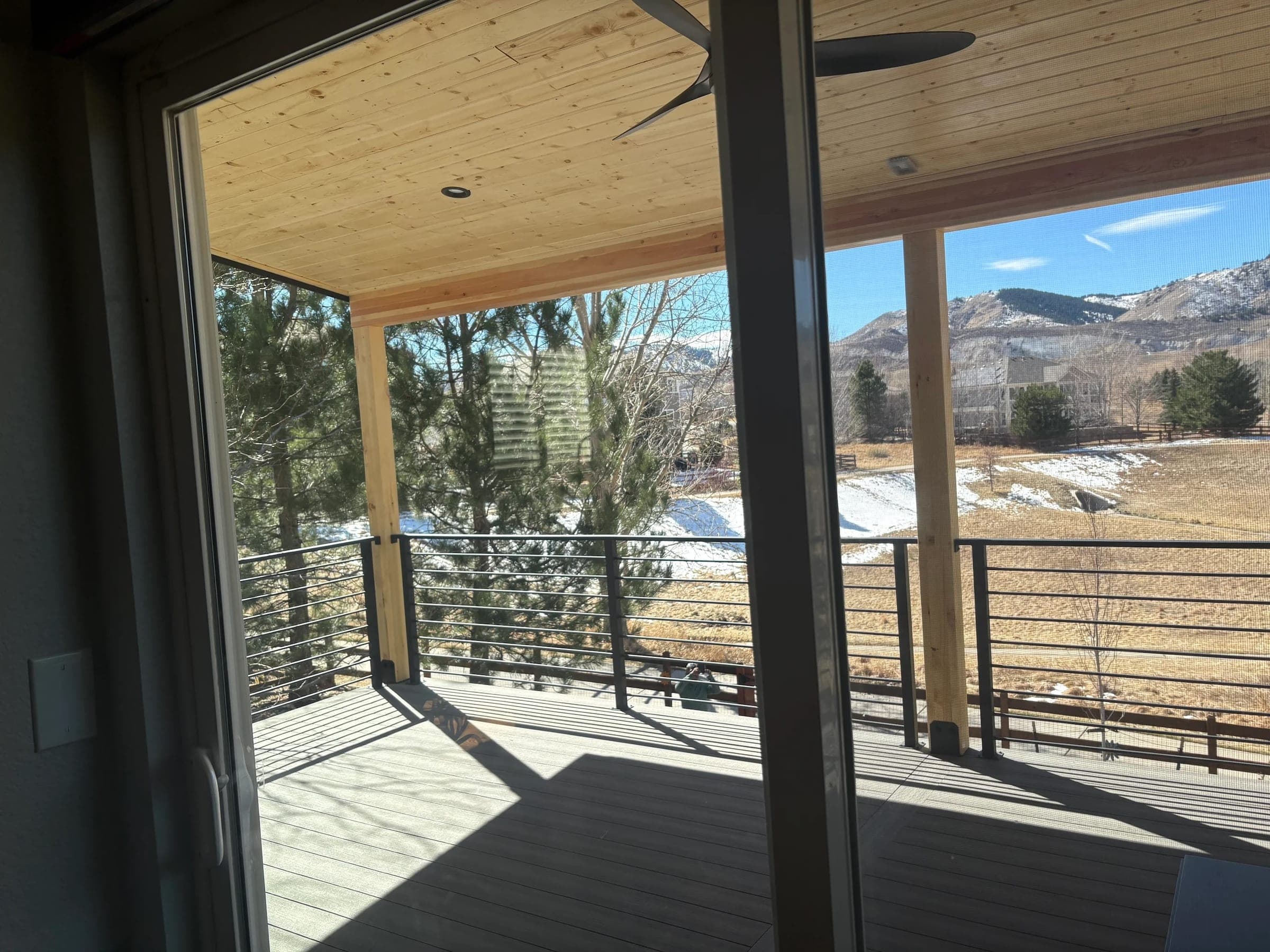
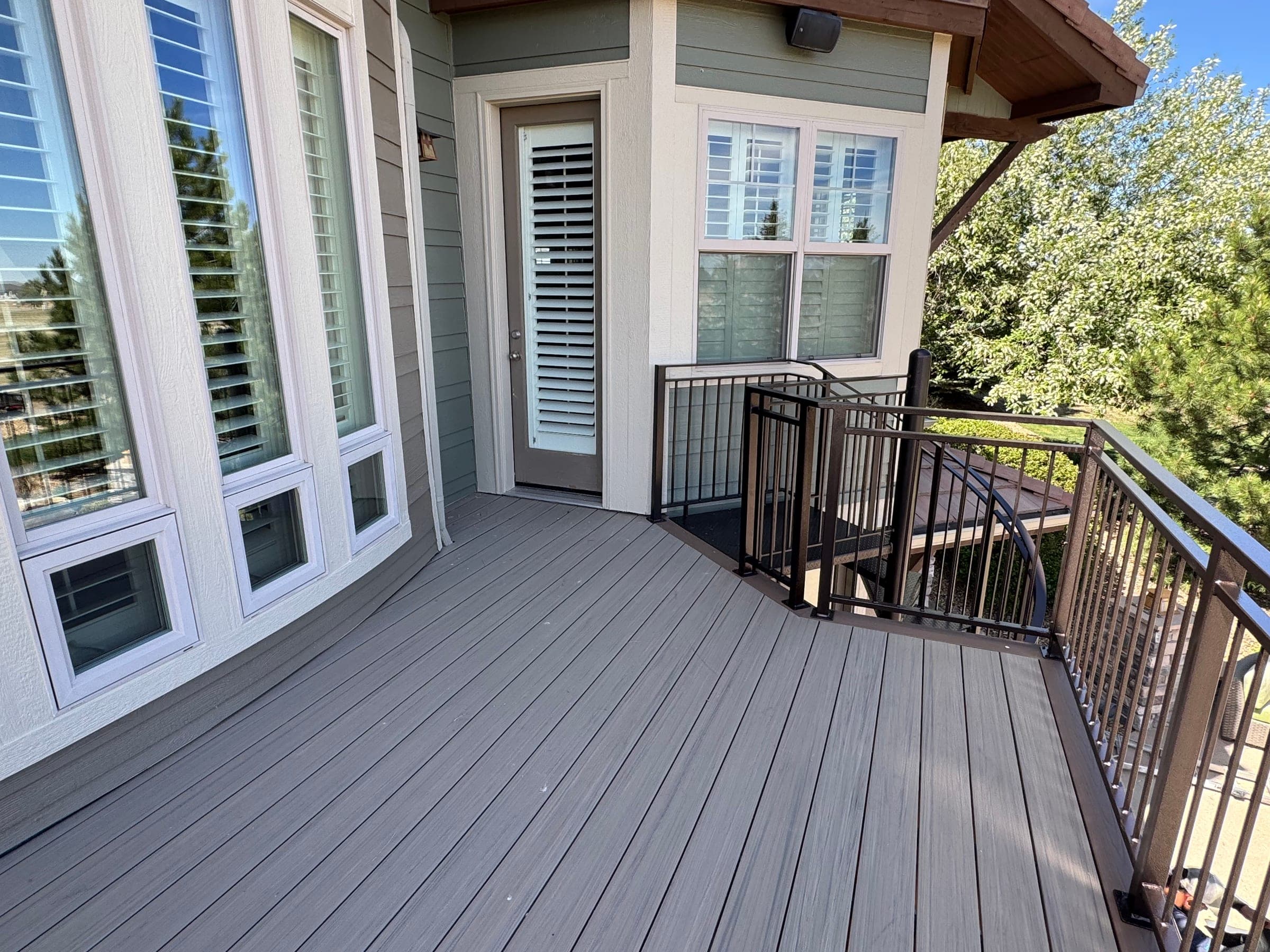
Replacing a deck railing in Denver runs $30–$150+ per linear foot installed depending on the system — most decks land in the $30–$90 band, putting a full replacement on a typical mid-size deck at $2,000–$8,000+. The deck stays; the railing goes. Here's the 2026 math, and the code your new rail has to meet.
Cost per foot
| Railing type | Installed cost per linear foot | Why you'd pick it |
|---|---|---|
| Composite / basic metal | $30–$60 | The value workhorse; matches a composite deck |
| Aluminum (powder-coated) | $60–$90 | Slim, no-maintenance, holds up in our sun |
| Cable rail (stainless) | $80–$130 | Gets the pickets out of a view |
| Glass panel | $100–$150+ | Maximum view, wind block |
A mid-size deck carries 60–70 linear feet of railing once you run the perimeter and the stairs. That works out to: composite or basic metal lands $2,000–$4,000; aluminum around $4,000–$6,000; cable and glass push $5,000–$8,000+. Stairs price above the flat runs — every piece cuts on an angle — covered in our stairs and railings cost guide.
Why railings fail
Three reasons, and only one of them is age.
Freeze-thaw works the connections loose. Colorado's daily freeze-thaw swing expands and contracts every joint, and the railing posts — tall levers bolted to the rim — feel it first: a post that moved a sixteenth of an inch a hundred cycles ago wobbles an inch today.
Altitude UV eats wood infill. At a mile up, UV runs roughly 25% stronger than sea level, so wood pickets bleach, check, and split years before the deck boards under your feet — which is why so many otherwise-sound decks wear a gray, splintering rail.
Code drift. Plenty of older metro decks — including many of Highlands Ranch's earliest builds — were built to rules that no longer exist — 32-inch rail heights, picket gaps over 4 inches, 2x2s toenailed to the rim. The deck was legal when it went in. The replacement rail won't be legal unless it meets today's numbers.
What code requires
A new railing doesn't get grandfathered — it meets current code, full stop:
- 36 inches minimum height wherever the deck surface is 30 inches or more above grade — the same threshold that makes a guardrail required at all.
- The 4-inch sphere rule. No opening in the infill — between pickets, under the bottom rail, at the stair transitions — can pass a 4-inch sphere.
- 200-pound load, any direction. The top rail has to resist a concentrated 200-pound push outward, inward, or down. This is what separates a railing from a decoration — carried entirely by the posts and their connections.
Every one of these is on the checklist in our permits and code guide, and inspectors check each one on a permitted job.
Which material is worth it?
| Priority | Best pick | The trade-off |
|---|---|---|
| Budget, match the deck | Composite | Chunkier profile, some sightline lost |
| Zero maintenance | Aluminum | Costs more up front, then nothing forever |
| The view | Cable or glass | The premium tier; cable needs occasional re-tensioning, glass needs cleaning |
| Warm wood look | Wood | Refinishing every 2–3 years in our UV — the maintenance you were likely escaping |
If your deck looks at the foothills or open space, cable and slim-profile aluminum get the rail out of the sightline — you're paying for the view, not the metal. If the old wood rail is why you're here, buying wood again just restarts the clock. Our railings page walks through how each system ages here.
What's involved
Less than a rebuild, more than a hardware run. The old rail comes off, the posts and their connections get evaluated — the posts matter more than the infill. A beautiful new railing on loose posts is furniture — it looks right and fails the 200-pound test. A proper replacement means posts through-bolted into sound framing, blocking added where the old build skipped it, then the rail system itself. Done right, it's a one-to-two crew-day job on most decks, covered under our workmanship warranty like any build.
Does a railing swap need a permit?
Usually not — a like-for-like railing swap is typically treated as repair, not construction, though every city draws that line slightly differently. Where the job grows structural, a permit often enters the picture, and we handle that process end to end.
When it's not a railing job
If a post wobbles because the rim joist it bolts to is soft, punky, or pulling off the house, no railing fixes that — that's a repair conversation first. Run our 10-minute safety inspection before you shop railings: probe the rim, check the ledger, look at the post bases. If something's off, deck repair comes first and the railing rides along on the same mobilization — cheaper than doing them a year apart.
Why fall is the right time
A railing swap is a short job, and fall is when crews have room in the calendar between the summer builds and the spring rush. You get scheduled in days instead of weeks, and the new rail is done before the first icy morning makes the old wobbly one a hazard. More on Colorado's build calendar here.
Want a real number for your deck? Reach out — we'll measure the perimeter, check the posts, and give you an itemized quote by system, not a ballpark.